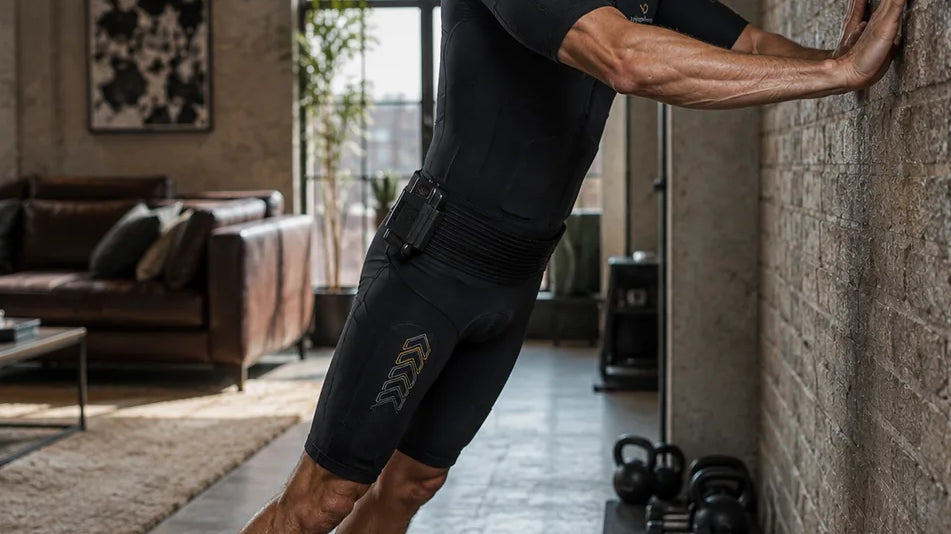
Short answer: yes. You can run a full whole body EMS session in your living room, using the same class of kit a studio straps you into, and the maths increasingly says you should. Ten years ago the only way to try EMS was to book a slot, pull on somebody else's damp base layer and pay boutique rates for 20 minutes. The suits are now wireless, dry electrode and app controlled, and one purchase costs less than a single year of sessions.
For the fundamentals of EMS training itself, the science and the safety rules, the hub guide has them. This page is the at home part.
We have done exactly that: three months of home sessions, two to three a week, written up with the schedule and the settings.
Here's the practical version: what to buy, what it costs against a studio, what a solo session actually looks like, and who should skip the idea entirely.
What you actually need
Search for EMS at home and you'll get everything from a $25 belt to a $3,000 suit, all wearing the same three letters. They are not the same product and they don't do the same job. Here's the split.
Tier one: ab belts and stick on pads, $30 to $100. Amazon and eBay list dozens of these between $13 and $40, most with an app, most promising a six pack. They do contract the muscle underneath them, so the marketing isn't lying exactly. What they can't do is train you. A belt reaches your abs and nothing else. That's one muscle group out of the eight to ten a studio session loads at once, running at a small fraction of the current, with no way to progress the load. Buy one expecting home EMS training and you'll be let down, then blame EMS rather than the belt.
Tier two: mid range stimulators, $150 to $400. Compex and Therabody's PowerDot live here, and the PowerDot Uno sits around $199. These are properly built units, worth owning for targeted work on one muscle, recovery protocols, or rehab on a joint you're nursing. It's closest to where EMS came from: physiotherapy clinics using it to fire muscles patients couldn't fire themselves. The catch is coverage. You're treating two or four sites at a time with pads and wires. Excellent for a quad. Still not a workout.
Tier three: full body suits, $1,890 and up. This is the tier that replaces a studio, because it's what studios use. A suit wires every major muscle group at once and a control box pulses through all of them while you move. The Visionbody PowerSuit is the one we use: 24 dry electrodes, so no gel and no pre soaking ritual, a wireless PowerBox, app control, machine washable, $2,490 list and frequently around $1,890 on sale, with a three year PowerBox warranty and no mandatory subscription. Katalyst is the other name you'll see at $2,999, plus a compulsory $35 to $49 a month for its app. We've put them side by side in the best EMS suits, ranked.
A rule of thumb that saves a lot of disappointment. If the device doesn't load your quads, hamstrings, glutes, abs, lower back, lats, chest and arms simultaneously, it's a recovery tool, not EMS training. Tiers one and two both have real uses. Neither substitutes for the suit.
The cost maths: home versus studio
This is where the home case stops being a preference and starts being arithmetic.
US studio sessions run about $35 to $60 each, with memberships around $199 to $250 a month. In the UK a single session is £55 to £60 and memberships run £139 to £249 a month. Those are published rates, not estimates, and we've broken the whole market down in our full EMS cost breakdown.
Now price the alternative. A PowerSuit on sale at about $1,890, less $56.70 with code ROUTINES50, lands at roughly $1,833.30. One payment. No membership, no contract, no minimum term, no per session fee ever again. Here's how that plays out, using $1,833.30 as the suit cost in every row.
| How often you train | One year of studio | Suit pays for itself in | Three years of studio |
|---|---|---|---|
| Once a week at $40 | $2,080 | 46 weeks | $6,240 |
| Twice a week at $40 | $4,160 | 23 weeks | $12,480 |
| Twice a week at $55 | $5,720 | 17 weeks | $17,160 |
| Two people, twice a week each, $40 | $8,320 | 12 weeks | $24,960 |
Take the middle row, because it's the one most people are actually choosing between. Two studio sessions a week at $40 is $80 a week and about $4,160 a year. The suit costs $1,833.30. You cross the break even line at 23 weeks, call it five and a half months, and every session after that costs you nothing. Not less. Nothing.
Stretch it to three years and the gap gets silly. Roughly $12,480 of studio sessions against a single $1,833.30 purchase. That's over $10,600 you keep, for the same 20 minutes twice a week, done in your own front room.
Two things the table can't show. The first is that a suit has no monthly fee, no contract to exit, no minimum term and no booking window. Studios sell you a subscription and an appointment. A suit sells you neither, so the month you get busy costs you nothing. The second is sharing. Two people in one home can train on one purchase, which is the bottom row of that table and the reason break even can land inside three months. Studios charge per body. Your suit doesn't care who's wearing it.
And then there's the part no spreadsheet catches. You can train at 6am before the house wakes up, or at 11pm after the kids are down, without booking anything, without driving anywhere, and without a stranger watching you do glute bridges. For a lot of people that beats the money.
Get the PowerSuit → before you run your own numbers, since the sale price moves. Code ROUTINES50 takes $56.70 off at checkout.
What a home session actually looks like
Less ceremony than you'd expect. The whole thing, door to door, is about 25 minutes.
You put the suit on over bare skin, or over a thin base layer if your system uses one. On a dry electrode suit there's no wetting, no gel and no spray bottle, so it's a straight pull on and clip up. Under two minutes once you've done it a few times. Tighten the straps until the electrodes sit flat with no air gap, because a loose electrode is the most common reason a session feels weak or patchy.
Then open the app, pair the PowerBox and pick a program. Strength, endurance, fat burn and recovery are the usual four, and the app runs the pulse pattern for you. Bring the intensity up channel by channel, one muscle group at a time, until each feels firmly loaded and no more.
Twenty minutes of slow, controlled movement. Squats, lunges, presses, rows, planks, held longer and moved slower than you'd do them unloaded. You're not chasing reps. The stimulation is the load, so the job is staying under control while it fires. Our piece on what the research actually shows covers why movement quality matters more than volume here.
Then you're done. Unclip, hang the suit to dry, and machine wash it every few sessions. That's the routine: once or twice a week, always with 48 hours between sessions.
Training safely on your own
Nobody is going to stop you cranking the dial, so you have to be the adult in the room. This is where first time home users get it wrong.
Start lower than you think you need to. Genuinely low, for the first two to four weeks, and one session a week rather than two. EMS recruits muscle harder than voluntary contraction does, so a hard week one produces the kind of soreness that ends the habit before it starts.
Drink properly before and after. Leave 48 hours between sessions, minimum, and never train two days running. That recovery window sits in the international WB-EMS guidelines for a reason, and it's the one rule worth being rigid about. Stop immediately if anything feels sharp or nervy rather than the deep, even squeeze you should be feeling. Sharp means an electrode is sitting badly or that channel is turned up too high.
Some people shouldn't use EMS at all: anyone with a pacemaker or other implanted electronic device, anyone who is pregnant, anyone with epilepsy, and anyone with a heart condition. Serious kidney conditions, uncontrolled hypertension, recent surgery and active hernias are also standard exclusions. None of this is medical advice. If you have any ongoing condition, check with a doctor first.
We've written the longer version of the self coaching problem in training safely without a trainer, which is worth reading before your first solo session.
Is a home suit worth it for you?
Here's the split as we see it.
Buy one if you'll realistically train once or twice a week for at least a year. That's the threshold. Below a year the studio maths is closer than it looks. Buy one if there's no EMS studio within sensible driving distance, which describes most of the country outside a handful of cities. Buy one if two people at home will use it, because the per person cost halves. And buy one if booking, driving and paying is the actual reason you don't train.
Don't buy one if you want somebody qualified running your intensity and watching your form. That's a reasonable thing to want, and it's the main thing a studio sells. Don't buy one if you're not sure you'll stick with it either. Do a studio block first. Four to six supervised sessions costs a couple of hundred dollars, teaches you what correct intensity feels like, and tells you whether you can tolerate the sensation at all, which varies enormously between people. It's the cheapest way to de risk a four figure purchase.
One more note. EMS works on top of your training rather than instead of it. Controlled trials, including the Kemmler group's work, show real strength and body composition effects, strongest in beginners and people coming back after time off. If you're already a serious lifter, a suit won't out perform a barbell. What it will do is give you a useful 20 minute session on the days you'd otherwise do nothing.
If you land on the buy side, the Visionbody PowerSuit is what we'd point you at: dry electrodes, wireless, no subscription, three year PowerBox warranty. Code ROUTINES50 gets you $56.70 off.
The economics here aren't a close call for anyone training twice a week. Five and a half months to break even, then years of free sessions on your own schedule. See what the suit costs today and use code ROUTINES50 for $56.70 off.
How to pay for it
Visionbody lists the single system at $1,890 at the time of writing, down from $2,490. There are two ways to pay at checkout, plus a third that is worth reading carefully.
Pay in full. $1,890 today by card, Apple Pay or Google Pay.
Pay a deposit. $890 today secures the order and the remaining $1,000 is charged to the same card later. Visionbody says you get a notification before that second charge. Their own pages describe the balance as due on delivery in one place and due at shipping in another, so confirm the timing before you order. This is Visionbody's own payment schedule rather than a loan, so there is no lender, no interest and no credit check. For most people it is the sensible middle option.
Monthly instalments. The US checkout also offers Shop Pay Installments, which is credit from a lender and subject to an eligibility check. We are not quoting a monthly figure, because the plan you are offered depends on your own eligibility and the terms change. Read the sample plans at checkout properly before you commit, because the cheapest looking monthly payment is not the interest free one. Checking your eligibility does not affect your credit score. Rates from 0-36% APR. Payment options through Shop Pay Installments are subject to an eligibility check and are provided by these lending partners: affirm.com/lenders. A down payment may be required, and quoted payments exclude taxes and shipping.
routines.club is not a lender and does not arrange credit. Prices and payment options checked 3 August 2026 and subject to change.
More from our EMS hub
Frequently asked questions
Can you really do EMS training at home?
Yes. A home suit runs the same 20 minute format studios use, two to three times a week with 48 hours between sessions. The Visionbody uses 24 dry electrodes and 12 channels, so there is no gel and no wetting, and the wireless PowerBox pairs to a free phone app over Bluetooth. What you give up is a trainer setting your levels for you.
What do you need to start EMS training at home?
Less than people expect. The box holds the PowerSuit, the PowerBox controller, an LP-E10 battery, a laundry net and a manual. You add a phone running the free iOS or Android app, a thin seamless base layer, a mat sized patch of floor, and water. No gel, no wetting, no weights and no subscription. Pairing is one front button held for about three seconds.
How much does an EMS machine for home use cost?
The Visionbody sells for $1,890 in the US, down from a $2,490 list price, and ROUTINES50 takes $56.70 off. European buyers pay €1.790. Katalyst is $2,999 plus a mandatory $35 to $49 monthly subscription. TitanBody is $1,895. SQAI is $2,795. Cheap factory suits from SBODY and BruteSuits sell for $399 to $830 with no published FDA clearance.
Is training at home as effective as a studio session?
The stimulus is the same if you run the same session honestly. What changes is the discipline around it. A studio trainer raises your levels, watches your form and stops you overdoing it, and at home all three become your job. A few supervised sessions first make the solo ones better. Evidence for whole body EMS is strongest in beginners and returners either way.
How much space do you need for a home EMS workout?
About a yoga mat plus room to extend your arms. The movements stay slow and simple, squats, lunges, rows and planks, because the current supplies the overload rather than heavy weight. There is no rack, no bench and nothing to store. The suit is the whole gym, and it folds away into a drawer with its laundry net when you are done.
Do you need a phone or an internet connection to use a home EMS suit?
You need a phone. The Visionbody PowerBox is controlled from the My Visionbody app on iOS or Android over Bluetooth, and the app runs the mandatory warm up and the per muscle levels that start at zero. Pairing means holding the front button about three seconds. Pulsing blue means not connected, solid blue means connected. There is no subscription attached to the app.
What should you wear for EMS at home?
A thin seamless layer, nothing more. No padding, no underwire and no thick seams, because anything bulky lifts the dry electrodes away from your skin and the stimulation goes patchy. You do not need special clothing bought for the purpose, and with dry electrodes there is nothing to wet or gel beforehand. Bare feet or trainers both work fine on a mat.
What does FDA clearance tell me about training alone at home?
More than you might guess. The suit you strap on at home is FDA cleared under 510(k) number K222386, granted February 2023 as a Class II powered muscle stimulator for muscle conditioning, so a regulator has examined the device. Clearance means the FDA found it substantially equivalent to one already sold, not an endorsement of your results. Safe solo training comes from the protocol on top of that: mandatory warm up, every muscle starting at zero, 20 minutes, 48 hours between sessions.
Is a home EMS suit cheaper than a studio?
At two sessions a week it isn't close. A studio at $40 a session costs about $4,160 a year, while a suit at roughly $1,833.30 after the ROUTINES50 discount is a single payment that breaks even in 23 weeks. Over three years that's about $12,480 of studio sessions against one purchase.