Short version: yes, whole-body EMS training works, with caveats worth understanding before you buy a package. The peer-reviewed evidence is strongest for muscle strength and, in the right people, for muscle mass and body composition. It is genuinely useful if you are time-poor, deconditioned, coming back from a layoff, or older and unable to train conventionally. It amplifies an honest training effort rather than replacing one, and it works best alongside a diet that is already pointed in the right direction. Bring those two things and the stimulus does the rest.
The research answers whether it works. For whether you will actually do it, our three month account of training in a suit covers the practical side: realistic frequency, the intensity levels you end up on, and how hard a session really is.
Related: EMS studios and prices in the UK →
Related: our complete EMS workout guide →
Whole-body electromyostimulation, usually shortened to WB-EMS, has moved from niche physiotherapy tool to high-street fitness product, complete with 20 minute sessions and confident before-and-after claims. That jump from clinic to studio is exactly why it deserves a careful read of the actual research rather than the marketing. Below we walk through what the controlled trials and meta-analyses say, where the effects are real, and where the hype runs ahead of the data.
What EMS actually is
First, a distinction that matters. The vibrating ab belts sold on late-night television are not what the research is about. Conventional single-pad EMS targets one muscle at a time, and those gadgets are weaker still. Whole-body EMS is a different animal. You wear a suit or vest fitted with electrodes that sit over the large muscle groups at once: chest, back, abdominals, glutes, thighs and arms. A trainer, or an app, controls the intensity while you perform slow, simple movements such as squats, lunges or presses. The electrical impulses make your muscles contract on top of the contractions you are already producing voluntarily. A typical session runs about 20 minutes, once or twice a week, which is a large part of the appeal.
The theory is straightforward. Ordinary training recruits muscle fibers through your nervous system, and the higher-threshold fibers only switch on when the effort gets genuinely hard. External stimulation can recruit more of those fibers sooner, which is why a short session can feel surprisingly demanding. That mechanism is real. The open question, and the one researchers have spent the last 15 years testing, is how much it translates into strength, muscle and fat-loss results you can actually measure.
What studies show for strength
Strength is where the evidence is most convincing. A 2021 systematic review and meta-analysis by Kemmler and colleagues in Frontiers in Physiology pooled 16 studies covering 897 non-athletic adults and found large effects on strength: a standardized mean difference of about 0.98 for leg extension strength and 1.08 for trunk extension strength, both statistically significant (Kemmler et al., 2021, Frontiers in Physiology). Effect sizes of that magnitude are not trivial. They sit comfortably in the range you would hope to see from a well-run resistance program. That pooled sample spanned ages 18 to 77 and included cohorts with conditions such as cancer, back pain and post-bariatric-surgery recovery, so the strength benefit is not limited to fit young volunteers.
What makes this notable is how little time produced those gains. In the Franconian Electromyostimulation and Golf Study, moderately active men trained just once a week for 20 minutes over 16 weeks and still recorded improved muscle quality alongside previously reported gains in trunk and leg-extensor strength (Zink-Ruckel et al., 2021, Frontiers in Physiology). In an older population, Kemmler and von Stengel's subanalysis of the TEST-III trial found leg extensor strength rose about 9.1% in lean older women using WB-EMS versus roughly 1% in controls (Kemmler and von Stengel, 2013, Clinical Interventions in Aging). The consistent theme across trials is that WB-EMS reliably raises maximal strength, often with far less time under load than conventional training demands.
Body composition and fat loss
Here the picture gets more nuanced, and honesty matters. WB-EMS is good at building or preserving muscle. It is much weaker as a direct fat-loss tool. The same 2021 meta-analysis that found large strength effects also reported a large effect on muscle mass, a standardized mean difference of about 1.23, but no statistically significant effect on total body fat mass (Kemmler et al., 2021). In plain terms, the suit helps you add or keep lean tissue, but it does not, on its own, reliably strip fat.
That does not make body-composition change impossible. Muscle is metabolically active, and trials in older adults show meaningful shifts. In the TEST-III subanalysis, appendicular lean mass improved while abdominal fat dropped about 1.2% in the EMS group and rose about 2.4% in controls (Kemmler and von Stengel, 2013). The FORMOsA-sarcopenic obesity study found strong effects on muscle mass, moderate effects on function, and only minor effects on fat in community-dwelling women over 70 (Kemmler et al., 2016, Osteoporosis International). The realistic read: expect firmer, stronger, better-composed muscle, and expect fat loss only if your diet and overall activity support it. There is a second, underrated angle here too. If you are dieting, holding onto muscle while the weight comes off is what keeps the result looking like a body-composition change rather than just a smaller version of the same shape, and building or preserving lean tissue is precisely what WB-EMS is good at.
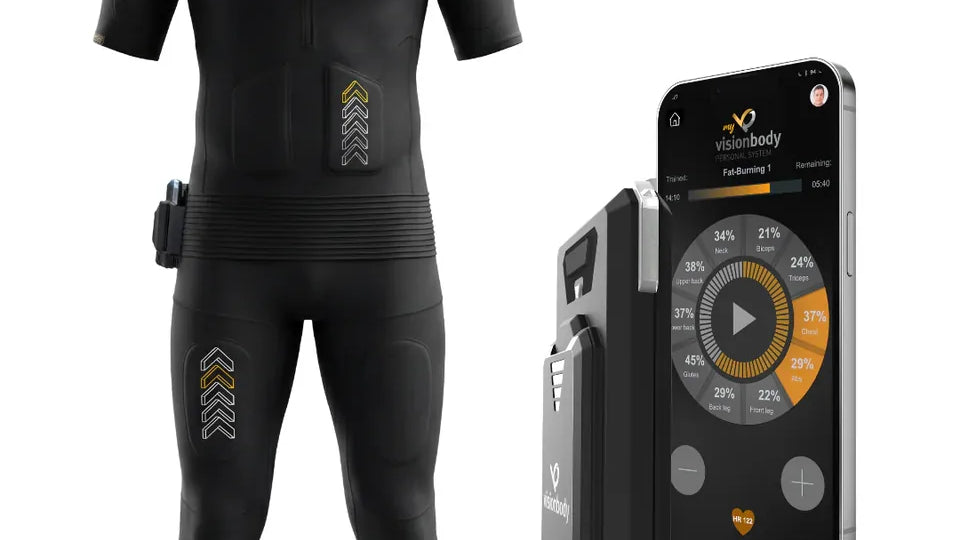
If you want to train this way at home rather than in a studio, a wearable suit can make once or twice weekly sessions realistic. We have used the Visionbody wearable EMS suit for exactly that, and Routines readers can use code ROUTINES50 for $56.70 off at checkout. Whatever kit you choose, the diet and consistency rules still apply.
Back pain
Chronic non-specific low back pain is one of the more compelling WB-EMS use cases, partly because it needs so little time. In a randomized controlled trial by Weissenfels and colleagues, 110 patients trained for 12 weeks. One group did 20 minutes of WB-EMS a week. The other did 45 minutes of a recognized back-strengthening program. Pain fell significantly in both groups, and the difference between them was not statistically significant (Weissenfels et al., 2019, BioMed Research International). In other words, a fifth of the time under a conventional program produced comparable relief. For people who avoid exercise because they are in pain or short on time, that trade is worth knowing about.
We would still frame this carefully. Back pain is complex, and no single tool fixes every case. But the controlled evidence here is genuine, and it lines up with the wider finding that WB-EMS strengthens the trunk efficiently.
Where the evidence is weak or overhyped
Now the caveats. The clearest one: WB-EMS looks far less special once you compare it against real training rather than against doing nothing. A mini-meta-analysis by Wirtz and colleagues pooled five controlled trials in moderately trained young adults and found the added benefit of WB-EMS over conventional strength training was negligible for maximal strength, a standardized mean difference of about 0.11, and for jump performance, about 0.01, with only a small possible edge for sprinting (Wirtz et al., 2019, Frontiers in Physiology). If you are already fit and training hard, do not expect the suit to unlock a new tier.
Two more honest points. First, the fat-loss marketing routinely overpromises. As above, the meta-analytic effect on body fat is not significant (Kemmler et al., 2021). Second, intensity has to be respected. Because WB-EMS drives so many muscles so hard, an over-aggressive first session can cause extreme muscle breakdown, a condition called rhabdomyolysis. The published safety guidance is explicit that beginners must not train to exhaustion and should build intensity gradually (Kemmler et al., 2016, German Journal of Sports Medicine; updated in the 2023 international position statement, Frontiers in Physiology). That is not a reason to avoid EMS. It is a reason to start conservatively with proper supervision or clear at-home guidance.
Who benefits most
Pulling the threads together, the research points to a few groups who get the most from WB-EMS. Time-poor people benefit because 20 minutes once or twice a week produces measurable strength gains. Deconditioned beginners and older adults benefit because the stimulus is strong without needing heavy loads or complex technique, and the FORMOsA and TEST-III trials were built around exactly these populations (Kemmler et al., 2016; Kemmler and von Stengel, 2013). People with chronic back pain, or those returning from a long break, benefit from the efficient trunk strengthening (Weissenfels et al., 2019). And a 2018 systematic review supports low-frequency WB-EMS as a safe, effective option for improving health-related outcomes in non-athletic adults more broadly (Kemmler et al., 2018, Frontiers in Physiology).
Who benefits least? Trained athletes chasing marginal gains, and anyone hoping the suit will substitute for a calorie deficit. For those goals, the data is underwhelming, and it is better to be told that up front.
Bottom line
Does EMS training work? For strength and, in the right people, for muscle and body composition, yes, and the effect sizes in the meta-analyses are real rather than rounding errors. It shines for people who are short on time, new to training, older, or working around pain. It disappoints as a standalone fat-loss device and as an upgrade for already-strong athletes. Treat it as a genuinely efficient way to make an honest effort count for more, pair it with sensible eating and enough protein, respect the intensity early on, and it earns its place. Expect a miracle and you will be let down. Expect a strong, time-efficient training stimulus and the research is firmly on your side.
More from our EMS hub
Frequently asked questions
Is EMS training scientifically proven?
There is a real body of research on whole body EMS, led largely by Kemmler and von Stengel, and it does show muscle and strength changes. What it does not show is a shortcut past training. Studies typically use 20 minute sessions once or twice a week, and the effects are clearest in beginners and returners. Proven is too strong a word. Supported in specific groups is more accurate.
Who does EMS training work best for?
Beginners and returners. If you have never trained, or you have been away long enough that your baseline has dropped, the research on whole body EMS looks strongest for you. People who already lift consistently see less from it, because they are already producing the stimulus EMS adds. It also suits anyone whose real limit is time, since sessions are 20 minutes, two to three times a week.
Does EMS help with fat loss, or only muscle?
EMS is a muscle stimulus first. Any effect on body fat comes indirectly, through the work you do in the session and through carrying more muscle, and it will not outrun your diet. Sessions are 20 minutes, two to three times a week, which is not a large amount of energy expenditure on its own. Use it to hold or build muscle while your eating does the fat loss work.
Does EMS do anything if you just stand still during the session?
The current will still contract the muscle, but you are leaving most of the benefit behind. Whole body EMS sessions pair the stimulation with slow, simple movements such as squats, lunges, rows and planks. The current supplies the overload rather than heavy weight, and the movement is what ties that contraction to a pattern you actually use. Standing still is the weakest version of the session.
How much EMS training do the studies actually use?
Less than most people assume. The published whole body EMS work typically uses 20 minute sessions, once or twice a week. Visionbody recommends two to three sessions a week with 48 hours between them. Nobody in the research is training daily, and the rest gap is deliberate, because excessive intensity carries a documented rhabdomyolysis risk. This is general information, not medical advice.
Does EMS still work if you already lift regularly?
It works, but less dramatically. The research is strongest in beginners and returners, and EMS is best understood as a supplement to training rather than a replacement for progressive resistance work. Trained lifters usually get more from it as extra weekly stimulus, or as a way to keep something going through a busy stretch, than as a new source of gains.
Visionbody is FDA cleared, so doesn't that prove EMS works?
It doesn't prove that, no, but it does tell you something real. Visionbody holds 510(k) clearance K222386, which means the FDA reviewed the device and found it substantially equivalent to a powered muscle stimulator already on the market. That covers the hardware, not your results. Results come from the training research, which looks best in beginners and returners. Still, you can pull that number up in the FDA database in minutes, and a suit that claims clearance without publishing a number gives you nothing to check.
How often should you do EMS training?
Most published protocols use one or two 20 minute sessions per week, and once weekly has produced measurable strength and muscle-quality gains in controlled trials. More is not automatically better, because the stimulus is intense and your muscles need recovery time between sessions.
Can EMS training replace the gym?
For deconditioned, older or time-poor people it can be an effective standalone stimulus for strength. For trained lifters it works better as a supplement, since studies show little added benefit over conventional training in people who are already fit.
Is EMS training safe?
It is safe when intensity is built up gradually. The main documented risk is rhabdomyolysis from over-intense early sessions, which is why published guidelines tell beginners never to train to exhaustion. Start light, stay hydrated, and follow proper supervision or a well-designed program.