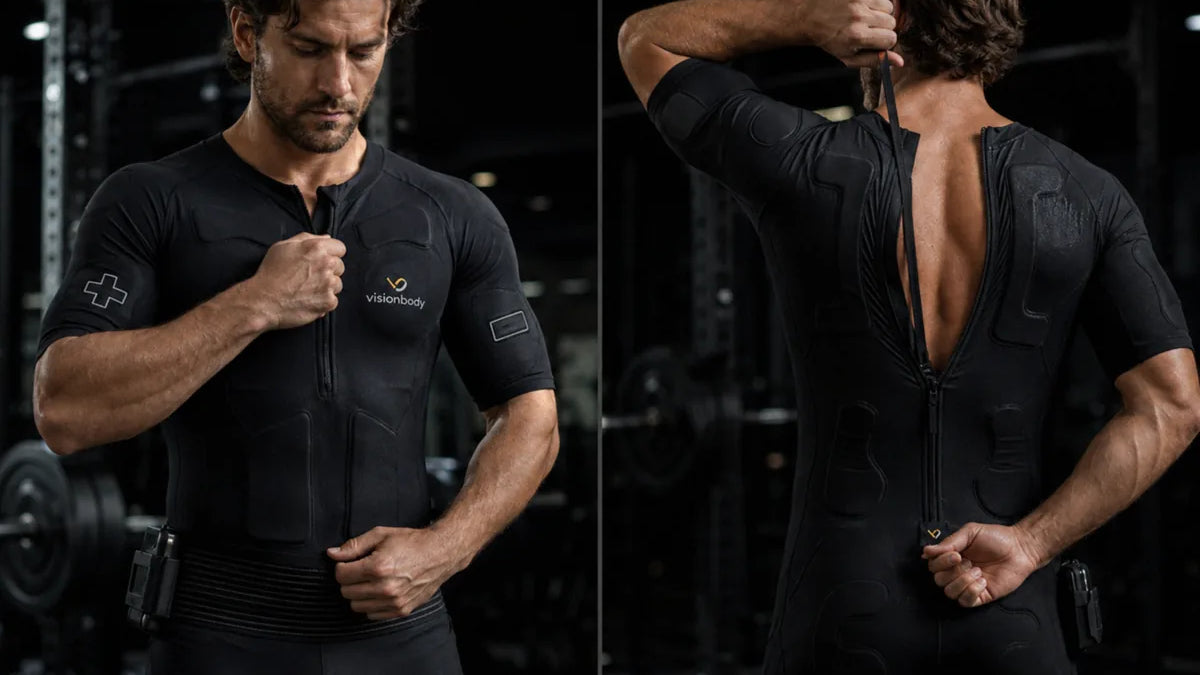
Studio EMS training has a math problem. A 20-minute session with a trainer runs $50 to $100 in most US cities, and the whole pitch of electro muscle stimulation is that you do it every single week. Stretch that habit over a year and you have spent more than the price of owning the hardware outright. In 2026 the home EMS suit market finally grew up, and for the first time we think a home suit is the smarter buy for most people who train consistently.
The short answer. An EMS suit is a wearable with built-in electrodes that contract your muscles while you move, so a 20 minute session works the whole body at once. Owning one runs roughly $1,900 to $2,800 up front, against $50 to $100 for every studio session, so a weekly habit pays for the hardware inside a year. Our pick is the Visionbody PowerSuit: 24 dry electrodes, no subscription, FDA cleared.
This guide is for exactly those people: you already work out, or you want a time-efficient way to start, and you are weighing a four-figure suit against a studio habit. We compared every consumer suit worth owning on current price, electrode count, wet versus dry electrode systems, subscription requirements, FDA clearance and the service record behind each brand. We checked every price against the manufacturer in July 2026, and where long-term durability mattered we leaned on extended tests like Outliyr's 2026 EMS suit field review and working trainers who own the hardware.
The short version: the Visionbody PowerSuit is the suit we would spend our own money on. It has the most electrodes of any home system, it is genuinely wireless, the dry electrodes kill the spray-bottle ritual entirely, and there is no subscription. Katalyst counters with the best workout app in the category, but you pay $2,999 up front and roughly $40 a month for as long as you use it. Everything else slots in behind those two.
Reader deal: Visionbody runs frequent sales (the single system was marked down from $2,490 to $1,890 when we last checked). Get the Visionbody → and enter code ROUTINES50 for $56.70 off at checkout.
| Suit | Price | Electrodes | Wet or dry | Subscription | Best for |
|---|---|---|---|---|---|
| Visionbody PowerSuit | $2,490 list, often $1,890 on sale | 24 (12 channels, incl. calves and shoulders) | Dry | None | Most people, self-directed training |
| Katalyst Gen4 | $2,999 + $35 to $49/mo | Not published (vest, arm straps, shorts) | Wet | Mandatory | Guided, coach-led workouts |
| SQAI Power Suit | $2,795 | Movable medical-grade pads | Wet | None | Custom fit, free class library |
| SBODY MD-K16 | From about $399 via resellers | 20 pads (10 channels) | Dry | None | Budget experiments, tinkerers |
| Wiemspro Revolution Pro | $995 suit + about $11,000 device | Pro configuration | Wet | None | Studios, not homes |
Related: everything you need to train at home →
Outside the US? buying an EMS suit outside the US →
Related: our Visionbody discount code page →
Related: Visionbody vs TitanBody, the new entrant compared →
1. Visionbody PowerSuit: the best EMS suit in 2026

Visionbody is not a startup chasing a trend. The German company built the world's first fully wireless EMS system back in 2014, founded by trainer Henri Schmidt, and the current PowerSuit is the product of a decade of iterating on one idea: make whole-body EMS something you can pull on and start in under two minutes.
Three things put it at the top of our list. First, coverage. The PowerSuit carries 24 electrodes across 12 channels, the most of any consumer suit we found, and it is the only one in this price class that hits calves and shoulders along with the usual chest, back, core, glutes, arms and thighs. More electrodes means the 20-minute session actually trains your whole body, not most of it.
Second, the dry electrode system. Katalyst and SQAI both need a water-sprayed base layer before every session for conductivity. Visionbody's electrodes work against bare skin and your own sweat. You skip the spray bottle, the damp undergarments and the extra laundry. It sounds like a small thing. After week three it is the whole thing, because setup friction is what kills home fitness habits. The suit itself is a machine-washable, antimicrobial silver-fiber garment, so maintenance is a laundry net and nothing else.
Third, the money. The system lists at $2,490, discounts frequently (it was $1,890 at the time of writing), and that is the last payment you make. No membership. The app, with 8 training programs and 64 subprograms claiming up to 98 percent muscle fiber activation, is free on iOS and Android. It is FDA cleared in the US and TÜV certified in Europe, and Visionbody will resize the suit free within six months if your body changes, which is a nice touch for people buying it to lose weight.
Now the honest cons, starting with one that has stopped being a con. For a long time the app was a remote control, not a coach: you set intensity per channel and had to know how to structure a session yourself, which is why Los Angeles EMS trainer Conrad Sanchez, who has used both systems, picked Visionbody for its simplicity and portability but warned that beginners would miss the guidance. Visionbody has figured that out. Their YouTube channel now carries a big library of follow-along workouts filmed in the suit, and those same videos are built into the app, so you can press play and train the way Katalyst owners do without paying a monthly fee for it. What is still true: the suit warranty is six months (the power box carries three years), shorter than rivals, and reviewers have flagged shipping waits of up to three months during demand spikes plus occasional Bluetooth dropouts mid-session. Fair criticisms. None of them change the fundamentals: best coverage, fastest setup, zero recurring fees.
Our pick: See current Visionbody PowerSuit pricing and use code ROUTINES50 for $56.70 off at checkout.

2. Katalyst Gen4: the best guided workouts, with the meter running
Two things to read before you pay for the meter: what the Katalyst membership costs over one, three and five years, and our straight answer to whether Katalyst is worth it.
If Visionbody is the hardware pick, Katalyst is the software pick. The FDA-cleared Gen4 system costs $2,999 and comes with a vest, arm straps, shorts, two base layers, the impulse pack and a spray bottle. That spray bottle matters: Katalyst is a wet system, so before every session you wet the base layers for conductivity. Owners report the prep settles into a three-to-five minute routine. Tolerable, never lovable.
What you get for the friction is the best training content in the category, and it is not close. The Katalyst app serves a library of over 100 video-guided classes where the impulse intensity adjusts automatically as the class moves between strength, cardio and recovery blocks. If you have never trained seriously and want to be told exactly what to do for 20 minutes, this is the system that will keep you moving. A Tom's Guide writer who wore one for a month came away sore, surprised and largely convinced, and Outliyr's reviewer stuck with it for 137 logged workouts, which says plenty about how engaging the app is.
The catch is the business model. A membership is required with purchase, from $49 monthly down to $35 a month on a three-year commitment, so call it $40. Over four years the true cost of ownership lands near $4,900, roughly double a Visionbody bought on sale. The suit is also close to useless without the app, it only runs on iPhone or iPad (iOS 16+), and the company's service record wobbled badly through 2025: Outliyr documented delivery delays, slow support and owner reports of $1,299 impulse pack replacements once out of warranty. The training experience is genuinely excellent. We just want you to buy it with clear eyes.
3. SQAI Power Suit: subscription-free, with a spray bottle
SQAI splits the difference between the top two. The Miami-based company sells a $2,795 system it describes as FDA cleared, though we could not find a 510(k) record under the SQAI name and it publishes no number, so ask them for it before you buy. It comes with suits handcrafted in Spain, and its app, including a library of instructor-led classes, is free forever. No subscription, full stop, which makes it the obvious alternative if you want guided content but refuse to rent your own equipment.
The suit is custom-fitted to your measurements and uses medical-grade electrode pads that can be repositioned or disconnected, a genuinely useful feature if you need to train around an injury. SQAI also offers a 30-day home trial, the most generous return window in the category.
Why third and not first? It is a wet system, so you inherit the same spray-and-base-layer ritual as Katalyst, and at $2,795 it costs more than a discounted Visionbody without matching its 24-electrode coverage. The brand is also younger than either rival, so long-term durability data is thin. Strong company, responsive support by most accounts, and the right pick for a specific buyer. Most people are better served above.
4. SBODY MD-K16: the budget wildcard
SBODY's MD-K16 is the suit for people who read this far and still cannot swallow a $2,000 price tag. Built by Chinese manufacturer Foshan Taimei and sold through resellers, it is a wireless, app-controlled (iOS and Android) dry suit with 20 electrode pads across 10 channels, and the silica-gel electrodes claim a five-year lifespan. Reseller pricing starts around $399 for basic configurations, a fraction of everything else here.
The compromises are real. We could not find any FDA clearance for the MD-K16, support depends entirely on which reseller you buy from, and there is very little independent long-term testing. If you are a curious tinkerer who wants to try whole-body EMS without committing real money, it is the least risky of the cheap options. If EMS is going to be a core part of your training, buy once and buy cleared hardware.
What to skip in 2026
Wiemspro makes excellent hardware, and that is exactly why you should not buy it for your living room. It is a professional system built for studios: the Revolution Pro suit itself is $995, but the device and software that drive it push a complete setup past $10,000, with reseller packages listed around $11,000 to $13,500. Unless you are opening an EMS studio, walk away.
Skip EasyMotionSkin too. The dry-electrode concept is sound, but reviewers found the company's website effectively dormant since 2023 and support hard to reach, and a four-figure suit from an unresponsive company is a paperweight in waiting. The same logic applies double to the unbranded EMS suits flooding marketplaces at $200 to $300: no FDA clearance, no parts, no recourse. A device that pushes electrical current through your torso is the wrong place to gamble on the cheapest listing.

Which EMS suit should you buy?
Here is the decision in four lines.
- You want the best overall suit and you can direct your own workouts: Visionbody. Most electrodes, dry system, wireless, no subscription, FDA cleared. Done.
- You need someone to coach you through every session: Katalyst, as long as you accept the $2,999 price, the wet prep and roughly $40 a month indefinitely.
- You want guided classes but refuse a subscription: SQAI, and use the 30-day trial aggressively.
- You are experimenting on a budget: SBODY, with your expectations set accordingly.
One more name worth a sentence: TitanBody, a newer $1,895 dry suit with a three-year power box warranty, took the top spot in Outliyr's 2026 rankings. It looks promising. We want a longer track record and clearer clearance paperwork before ranking a young brand above hardware that has survived a decade of real-world use, but keep an eye on it.
Still deciding? The Visionbody PowerSuit is the one we recommend to friends. Get yours → and don't forget code ROUTINES50 for $56.70 off at checkout.
Is a home EMS suit worth it vs studio sessions?
We came at this from the studio side: one paid session, then a suit. Three months later, here is how that decision held up.
Run the numbers. Studio EMS sessions typically cost $50 to $100 for 20 minutes with a trainer. At one session a week, that is $2,600 to $5,200 a year, every year. A Visionbody bought on sale pays for itself in well under a year, and a full-price Katalyst with membership breaks even against the average studio somewhere in year two.
What the studio still buys you is supervision. A trainer sets intensity conservatively, watches your form and stops you from doing too much too soon, which matters because first-timers reliably underestimate EMS soreness. Our honest recommendation: book two or three studio sessions first. Learn what correct intensity feels like, confirm you actually enjoy the modality, then buy the suit and keep the savings. If you already train and know your body, skip the studio phase entirely.
How to pay for it
Visionbody lists the single system at $1,890 at the time of writing, down from $2,490. There are two ways to pay at checkout, plus a third that is worth reading carefully.
Pay in full. $1,890 today by card, Apple Pay or Google Pay.
Pay a deposit. $890 today secures the order and the remaining $1,000 is charged to the same card later. Visionbody says you get a notification before that second charge. Their own pages describe the balance as due on delivery in one place and due at shipping in another, so confirm the timing before you order. This is Visionbody's own payment schedule rather than a loan, so there is no lender, no interest and no credit check. For most people it is the sensible middle option.
Monthly instalments. The US checkout also offers Shop Pay Installments, which is credit from a lender and subject to an eligibility check. We are not quoting a monthly figure, because the plan you are offered depends on your own eligibility and the terms change. Read the sample plans at checkout properly before you commit, because the cheapest looking monthly payment is not the interest free one. Checking your eligibility does not affect your credit score. Rates from 0-36% APR. Payment options through Shop Pay Installments are subject to an eligibility check and are provided by these lending partners: affirm.com/lenders. A down payment may be required, and quoted payments exclude taxes and shipping.
routines.club is not a lender and does not arrange credit. Prices and payment options checked 3 August 2026 and subject to change.
More from our EMS hub
Frequently asked questions
Do EMS suits actually build muscle?
They contribute, and most clearly in beginners and returners, which is where the whole body EMS research from Kemmler and von Stengel is strongest. Studies typically run 20 minute sessions one or two times per week. The honest framing is that EMS supplements training rather than replacing progressive resistance work. If you already lift seriously, expect a smaller effect than someone coming back after time away.
Are home EMS suits safe to use without a trainer?
Reasonably, if the system starts every muscle group at zero and you respect the limits. The main documented risk is rhabdomyolysis from excessive intensity, which is why the standard protocol is 20 minute sessions, two to three per week, with 48 hours of rest between. Avoid whole body EMS entirely with a pacemaker or implanted device, pregnancy, epilepsy, serious heart conditions, active cancer, fever, or open wounds. 18+ only. General information, not medical advice.
What is the difference between a wet and a dry EMS suit?
Wet systems need the contact points dampened before every session so current passes cleanly, which adds a preparation step and puts more moisture through the fabric. SQAI is a wet system at $2,795. Dry systems skip all of it: Visionbody's 24 electrodes need no gel or wetting, and TitanBody uses 20 dry electrode zones. Dry is faster to start and simpler to look after.
How much does a good EMS suit cost in 2026?
Real home systems cluster in a fairly narrow band. Visionbody is $1,890 against a $2,490 list, TitanBody is $1,895 solo against a $2,495 regular price, SQAI is $2,795, and Katalyst is $2,999 plus a mandatory $35 to $49 monthly subscription. ANTELOPE sells around 999 euros on sale in the EU. Studio grade rigs from Wiemspro and XBody run $8,500 to $20,000 and beyond.
Which EMS suit is best for a complete beginner?
Visionbody, mostly for the guardrails and the cost structure. Every muscle group starts at level 0 and rises individually behind a mandatory in app warm up, the electrodes are dry so there's no prep ritual to get wrong, and no subscription keeps billing you while you work out whether EMS suits you. Beginners are also the group the research supports most clearly.
Which EMS suit costs least over three years?
Compare the recurring fee, not just the sticker. Katalyst is $2,999 and then $35 to $49 every month for as long as you keep training, so the gap widens each month you own it. Visionbody at $1,890 and TitanBody at $1,895 have no subscription at all. Then budget for a replacement suit eventually, since Visionbody warrants the functional components for 100 wash cycles and a new Ultimate Suit 5.0 is $489.
Are the cheap EMS suits on Amazon worth buying?
Factory suits from names like SBODY and BruteSuits run $399 to $830 with no published FDA clearance. You're buying an unknown current profile on a device whose main risk is delivering too much of it. If budget is the constraint, a studio session or saving longer is the safer call. Whole body EMS is one of the few pieces of home equipment where the cheap version carries real risk. General information, not medical advice.
Do I need an iPhone to use an EMS suit?
For some suits, yes. Katalyst is iOS only, so an Android phone rules it out completely. Visionbody's app is free on both iOS and Android, and the suit pairs over Bluetooth with the wireless PowerBox: hold the front button about three seconds, pulsing blue means not connected, solid blue means connected. Check platform support before buying, because it isn't something you can work around later.
Which EMS suits have an FDA clearance you can actually check?
Visionbody and Katalyst. Visionbody's is K222386, cleared February 2023, and Katalyst holds K171035 and K181199. TitanBody and SQAI both claim clearance without printing a number, and we searched the FDA 510(k) database under those names and TitanBody's known parent brands and turned up no record, so ask them for it before you buy. Clearance means the FDA found a device substantially equivalent to one already on the market, not proof of any result. Visionbody's you can verify yourself in about two minutes, which is why it heads our list.
Are home EMS suits safe?
Visionbody and Katalyst both hold clearances you can look up: Visionbody is 510(k) K222386 and Katalyst is K171035 and K181199, which means the FDA found each device substantially equivalent to one already on the market. SQAI describes itself as FDA cleared but publishes no number and we found no record, so ask for it. EMS is not for everyone: skip it if you have a pacemaker or other implanted electronics, are pregnant, or have epilepsy, and talk to your doctor if unsure. Start at low intensity once a week, because overdoing early sessions causes brutal soreness.