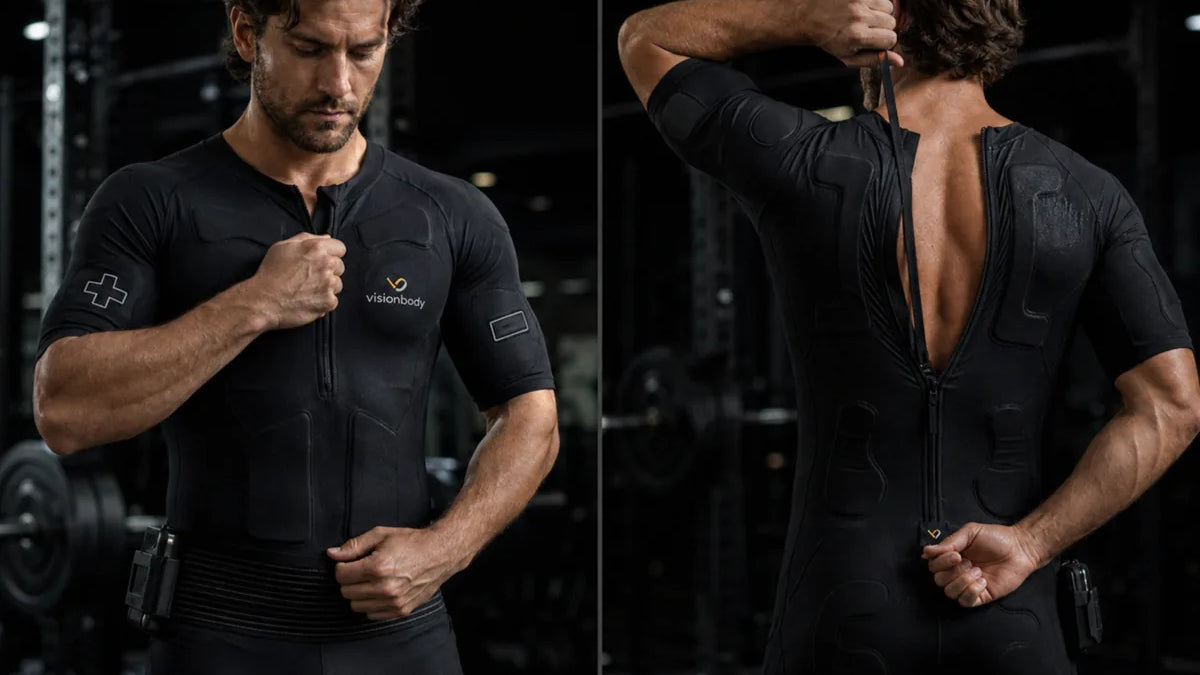
I bought this suit with my own money in June 2025. I run this site, and we earn a commission if you buy one through our link. Nothing below was written for Visionbody or checked by them.
I have been using a Visionbody single system for about six months. I paid $1,890 for it at the US store, and the block of use I can actually put numbers on is three months of two to three sessions a week from August to November 2025, with a weights session or two alongside. This is the review I wanted to read before I bought one and could not find, because the reviews I found before buying were either spec sheets or affiliate pages that read like nobody had worn one.
Short version: it is a real training stimulus, it is a good piece of hardware, the app is fine rather than great, and the reason I would buy it again has almost nothing to do with the marketing. It is a hard twenty minutes I will actually do at 9pm on a Tuesday. If that sounds like you, keep reading. If you already train four times a week and enjoy the gym, you probably do not need it.

What I bought and what it cost
The single Personal System, from the US store, in June 2025. One PowerSuit, one PowerBox, the belt, the charger, a wash bag and the app. $1,890, which was the sale price then and is still the sale price now against a $2,490 list. I did not have a discount code at the time. If you buy through our link, ROUTINES50 takes 3% off, which on this product is $56.70 and brings it to $1,833.30.
I bought the single rather than the DUO because I was the only one using it. If two of you will train, the two suit bundle is cheaper than buying a second suit later, and we go through the maths in what a Visionbody actually costs.
Setup and the first session
Visionbody says you can be in the suit and training in under two minutes. That is true after the first week and not true on day one. The first session is a calibration, not a workout. You pull the suit on, clip the PowerBox to the belt, pair it over Bluetooth, and then spend most of the twenty minutes finding out what each muscle group can tolerate, because every channel starts at zero and the levels you land on are nothing like each other.
There is no water, no spray bottle and no gel. The electrodes work with sweat, and the suit is snug enough that contact is good from the start. That is the single biggest practical difference from the wet suits, and after six months it is the thing I would least want to give up. Our setup and first session guide walks through it step by step if you want the detail.
Three months in it
I ramped, and I would tell anyone to ramp. Two sessions a week for the first three weeks, then three a week with at least 48 hours between them. Whole body EMS recruits a lot of muscle at once and the soreness after an early session is not normal soreness. Going again the next day would have been a mistake.
| Period | Sessions per week | Rest between |
|---|---|---|
| Weeks 1 to 3 | 2 | About 72 hours |
| Weeks 4 to 12 | 3 | 48 to 72 hours |
On intensity, the number nobody publishes: my abs topped out at about 20% and my chest ran as high as 70%. Everything else sat somewhere between. Expect a three to four times spread between your lowest and highest channel, and expect the first two or three sessions to be about finding those numbers. If you set every channel to the same level, your abs decide the session and your chest gets nothing.
I used two of the programmes and ignored the rest. Muscle building twice a week, which is the one that leaves you properly tired, and fat loss once a week as the lighter third session. The full week by week account, including everything else I was doing around the suit, is in my three month log. I am not going to put a body composition number in this review, because I was also lifting, eating 200 grams of protein a day and taking creatine, and any figure I gave you would be four things pretending to be one.
What a session feels like
Every ad sells convenience. Twenty minutes, no gym, no commute. All true, and all of it makes EMS sound like you stand there while the machine works. It is not that.
Twenty minutes with the channels set properly is work. By the end I am drenched, the way I am after a real gym session, and then I get a couple of hours of feeling like I could take on anything. That afterglow is the honest reason I kept going three times a week rather than letting a $1,890 purchase live in a cupboard, which is what happens to most home fitness gear.
So the pitch I would make is not that it is easy. It is that it is a hard twenty minutes that is genuinely convenient, and it pays you in dopamine at the end.

Build, battery and the 100 wash limit
The suit is a compression garment with the electrodes sewn in, and it has held up. The PowerBox is small, clips to the belt, and charges over USB-C. It runs on Canon compatible LP-E10 cells, which matters because a spare battery costs a few dollars from any camera shop rather than whatever a proprietary pack would cost. I have not run a stopwatch on the battery, so I am not going to quote you an hours figure. What I can say is that it has never died on me mid session.
Things I have not tested and will not pretend to have: an exact battery figure in hours, a warranty claim, and how the suit fits at a body type that is not mine. If any of those decides it for you, ask Visionbody directly before you buy.
The thing to go in with your eyes open on is the textile warranty. The PowerBox carries three years, but the suit electricals are covered for six months or 100 wash cycles, whichever comes first, and the fabric itself for 30 days. On a $1,890 product that is thin, and it is the reason the $489 replacement suit exists. Wash it every three or four sessions rather than every time, in a mesh bag on a gentle cycle, and air dry it. Register it the day it arrives, because the warranty is void if you do not.

The app, honestly
It does the job. Per channel intensity, a mandatory warm up, eight programmes with sub programmes, and it runs on both iOS and Android, which Katalyst's does not. It is not a coach. There is no voice in your ear, no adaptive programming, no one telling you when to push. If you are the kind of person who needs that to train at all, Katalyst's app is better and you should read our Visionbody against Katalyst comparison before deciding, because that is the real trade between the two suits. If you can follow a plan on your own, the Visionbody app is enough and you keep $35 to $49 a month.
What annoys me
- The wash limit. Six months or 100 cycles on the electricals of a $1,890 suit. It is the weakest part of the offer and Visionbody does not lead with it.
- Nothing tells you where to start on intensity. The app starts every channel at zero and leaves you to it. A sensible default per muscle group would save every new owner two sessions of guessing.
- Their popup offers fight your discount code. Visionbody runs its own promotions, a cart only takes one code, and we have watched theirs replace ROUTINES50 in the cart without saying so. Check the total reads $1,833.30 before you pay.
- The first session is not a workout. Nobody warns you. Budget it as setup.
Who should buy it, and who should not
Buy it if you are short on time and have quit a gym before, if you want a session you can do at home with no prep, or if you have tried a studio session and felt the thing I described above and want that three times a week without paying $35 to $60 a time. It is also the right choice if you are on Android, since the main alternative is not.
Do not buy it if you already train four or more times a week and like the gym, because it will not replace that. Do not buy it if you need to be coached through every session. And do not buy it expecting it to replace lifting. I kept lifting once or twice a week the whole time and I would do that again.
If you are not sure, do what I did. Book one studio session first. It costs $35 to $60 and it tells you in twenty minutes whether this is for you. Find one near you here.
And if you want to see it next to Katalyst, SQAI and the budget suits before you decide, read how it compares to the other EMS suits.


What's in the box and the specs that matter
Everything below is from my own kit and Visionbody's warranty terms, not their marketing page.
| Item | What it is |
|---|---|
| PowerSuit | Compression suit with 24 dry electrodes on 12 channels. Machine washable in a mesh bag, gentle cycle, air dry. |
| PowerBox | The controller. Clips to the belt, pairs over Bluetooth, charges over USB-C, runs on a Canon compatible LP-E10 cell you can buy anywhere. |
| App | iOS and Android. Per channel intensity, mandatory warm up, 8 programmes with 64 sub programmes. |
| Also in the box | Belt, USB-C charger, wash bag. |
| Replacement suit | Ultimate Suit 5.0, $489. Pairs with the PowerBox you already own. This is the part that wears out. |
| Support belt (optional extra) | $39. Not in the box, and I did not buy one. |
| Warranty | PowerBox 3 years. Suit electricals 6 months or 100 wash cycles, whichever first. Textiles 30 days. Registration required or it is void. |
| Price | $1,890 US against a $2,490 list. €1.790 on the EU store. Code ROUTINES50 takes 3% off either. |
Safety, and what FDA cleared means
The Visionbody system is FDA cleared under 510(k) number K222386. Cleared means the FDA found it substantially equivalent to a device already on the market. It is a real regulatory review you can look up by that number, and it is not a promise of any fitness result. Visionbody's own site sometimes says approved. It is cleared. The distinction matters and we keep to it.
The app enforces a warm up and caps session length, and stimulation stops if the connection drops or the PowerBox is detached. Some people should not use whole body EMS at all: anyone with a pacemaker or implanted electronics, a seizure disorder, a serious heart condition, or who is pregnant, and anyone in cancer treatment should ask their doctor first. Start lower than you think you need to. The documented risk with EMS is going too hard too early, and it is avoidable if you ramp. Our safety guide covers the contraindications properly.
How the Visionbody compares in 2026
There are three suits I would take seriously, and I looked at all three before buying. This is how they line up on the things that decided it for me.
| Suit | Price | Electrodes / channels | Subscription | Best for |
|---|---|---|---|---|
| Visionbody PowerSuit | $2,490 list, often $1,890 | 24 / 12 | None | The one I bought. Most electrodes, no monthly fee. |
| Katalyst | $2,999 | 20 / 10 | $35 to $49 a month, mandatory | People who want a heavily guided iOS app and accept the fee. |
| TitanBody | $1,895 | 20 / 10 | None | Lowest list price, but the brand launched in late 2025 with little long term feedback. |
Over three years the subscription is what separates them. Katalyst adds roughly $1,260 to $1,764 in fees on top of its higher purchase price, which is more than the entire gap between the three suits. Full breakdowns: Visionbody vs Katalyst and Visionbody vs TitanBody.
Two things I would ask Visionbody before paying
Neither is answered clearly anywhere on their site, and both are worth one email to support before you spend the money.
Who services the warranty where you live. The terms are in the table above. The wording says faulty components go back through an authorised retailer or dealer rather than to Visionbody directly, and no international dealer is named. If you are outside the US, ask who that dealer is before you buy, not after something breaks.
Where your suit ships from. The US store ships from Miami. If you are in Europe, buy from the EU store in euro rather than importing from the US, or you will pay VAT and duty on top. We covered the detail in buying a Visionbody outside the US.
Where to buy it, and how I would pay
The single system is $1,890 at the official US store. Code ROUTINES50 takes 3% off, which is $56.70 on this product, bringing it to $1,833.30. The code should apply through our link. Check the total before you pay, and if it is missing, type ROUTINES50 into the discount field yourself. European buyers pay €1.790 on the EU store and the same code takes 3% there too.
Three ways to pay at checkout. In full, by card, Apple Pay or Google Pay, which is what I did. A deposit, $890 now and $1,000 charged to the same card later. That is Visionbody's own schedule rather than a loan, so no lender, no interest and no credit check, and it is the sensible middle option if the full amount stings. Their pages describe the balance as due on delivery in one place and at shipping in another, so confirm the timing. Monthly instalments through Shop Pay, which is credit from a lender with an eligibility check. I am not quoting a monthly figure because the plan you are offered depends on you. Read the sample plans at checkout properly, because the cheapest looking monthly payment is not always the cheapest plan.
More from our EMS hub
Frequently asked questions
Is the Visionbody EMS suit worth it?
It depends on whether you'll actually use it. At $1,890 in the US, with ROUTINES50 taking $56.70 off against a $2,490 list price, it's a real purchase. There's no subscription afterwards, so the spending stops there apart from an eventual replacement suit. Worth it if you'll train two or three times a week, which is exactly the pattern the research supports. Less so if you expect it to replace progressive resistance work, because the evidence treats EMS as a supplement to training.
How much does the Visionbody suit actually cost?
In the US it's $1,890, down from a $2,490 list price. Europe is priced separately in euros at €1.790 on both the EU and DACH stores. ROUTINES50 takes $56.70 off at checkout. Shipping across the USA is free from the Miami warehouse; international shipping is calculated at checkout, and customs or import VAT are yours if the order crosses a border. There's no subscription, so nothing recurs after you pay.
Does Visionbody require a subscription?
No. The My Visionbody app for iOS and Android comes with the system, and Visionbody's own comparison table lists paid membership as not applicable. That's the main structural difference against Katalyst, which charges $35 to $49 per month on top of a $2,999 suit. Your only real ongoing Visionbody cost is a replacement Ultimate Suit 5.0 at $489 once the fabric wears out.
Is the Visionbody suit FDA cleared?
Yes, and the number is public. Visionbody holds 510(k) clearance K222386, granted 24 February 2023 to VB Technologies AG, listed as a Class II powered muscle stimulator for muscle conditioning under regulation 890.5850. You can verify it yourself in the FDA 510(k) database. Clearance means substantial equivalence to an existing device, not an FDA endorsement of results.
What actually comes in the box?
A PowerSuit carrying 24 dry electrodes across 12 channels, the wireless PowerBox controller, an LP-E10 rechargeable battery, a laundry net for washing, and the manual. The app is a free download on iOS and Android. Nothing needs gel or wetting, and there's no special clothing to buy beyond a thin seamless layer worn underneath with no padding or underwire.
Does the Visionbody suit hurt?
It shouldn't. Every muscle group starts at level 0 and you raise each one individually during a mandatory in app warm up, so you set the ceiling, not the app. The sensation is a deep involuntary contraction that feels strange the first few times rather than painful. If anything turns sharp or burning, drop the level. Visionbody's guideline is to keep your heart rate near 180 minus your age. General information, not medical advice.
How long does the suit last before it needs replacing?
Visionbody covers the PowerSuit's functional components, the electrodes, wiring and connection plate, for six months or 100 wash cycles, and the textile for 30 days, so treat the fabric as a wear item. A replacement Ultimate Suit 5.0 is $489. The electronics are built to outlast it, and the PowerBox carries a three year warranty. Care extends the fabric's life: cold gentle cycle, 800 rpm spin, bleach free detergent, laundry net, dried flat out of direct sunlight. No softener, no tumble drying.
Who should not use the Visionbody suit?
Whole body EMS carries standard contraindications: a pacemaker or any implanted electronic device, pregnancy, epilepsy, serious heart conditions, active cancer, fever, and open wounds or acute injury over the electrode areas. It's 18+ only. Excessive intensity carries a documented rhabdomyolysis risk, which is exactly why sessions start at zero, stay at 20 minutes, and leave 48 hours between. Ask your doctor first. General information, not medical advice.
Can two people share one Visionbody suit?
Physically yes, practically it comes down to fit. There's no published size chart. Visionbody emails you for measurements after you order, so the suit arrives sized to one person, and a second user of a very different build won't get clean electrode contact. Hygiene matters too, since the suit needs washing every two to three sessions regardless. If you want a second suit, ask support-usa@visionbody.com rather than trusting third party pricing.
Does the person who wrote this review actually own the suit?
Yes. I bought the Visionbody single Personal System from the US store in June 2025 for $1,890, with my own money, and the three month block of use described in the review ran from August to November 2025 at two to three sessions a week. Visionbody did not supply the suit, did not pay for the review and has not seen it. We earn a commission if you buy through our link, which is disclosed at the top of the page.
Do you need a trainer to use it?
No, and I have never used one with it. The app gives you the programmes and lets you set every muscle group's intensity yourself. What it does not do is coach you. There is no voice telling you when to push and no adaptive plan. If you can follow a written plan, that is enough. The rules that matter are starting far lower than you think you need to, keeping sessions to 20 minutes, and leaving 48 hours between them. We go through it properly in training without a trainer.