Yes. You can run EMS training without a trainer, and plenty of people do it every week with a home suit. But it has conditions, and anyone selling you a suit without naming them isn't doing you a favor. Solo EMS is safe if you start far lower than you think you need to, keep sessions to 20 minutes, leave 48 hours between them, and stop the second anything feels sharp rather than strong. The danger in EMS has never really been the technology. It's the beginner who pushes the dial to 70 percent on day one because it doesn't hurt yet.
Be aware of the other side. The researchers behind the 2023 international WB-EMS position statement argue against unsupervised private use altogether, and that isn't studio industry noise. It comes from real case reports. But it was written with commercial equipment and walk-in novices in mind, and it maps poorly onto a guided app program run at low intensity, once a week, at home.
What a trainer actually does in a studio session
Strip out the boutique lighting and a WB-EMS trainer does five jobs.
- Screens you. A questionnaire checked against the published contraindication list. Four minutes, and it matters more than the other four combined.
- Fits the suit. Electrodes need firm, even skin contact. A trainer tightens the straps and spots the gap that would leave a zone feeling dead all session.
- Sets intensity zone by zone. The skilled part. Each muscle group gets its own level, raised slowly while the trainer watches your face.
- Programs the session. Frequency, pulse width, intervals, and what you do while the current runs. Looks the most like expertise, easiest to automate.
- Watches you and pulls you back. Germany's DIN standard for commercial WB-EMS caps the trainer to participant ratio at 2:1 for exactly this reason.
Europe adds a legal layer. Germany regulates commercial EMS under the NiSV, and since January 2023 the person operating the device on a paying customer must hold certified competence in electromagnetic fields, renewed every five years. The scope matters: it covers commercial operation, someone applying current to another person's body for money, and says nothing about your own suit at home. But it shows how seriously regulators take an intensity dial in untrained hands.
What replaces the trainer at home
Most of those jobs have a home equivalent, one gets harder, and one has no substitute.
Screening is on you, and takes five minutes. The contraindication list is below. Read it honestly, and see a doctor before you buy rather than after.
Fit is mostly solved at purchase. Visionbody doesn't publish a size chart. It emails you for measurements after you order and matches the suit to your body. After that, smooth every panel flat before fastening the closures. Our guide to how to set up and run your first session covers fit and pairing.
Programming is genuinely solved. The My Visionbody app ships with eight guided training programs covering strength, toning, body sculpting, fat burning, cardio, recovery, posture and coordination, plus more than 60 subprograms and no subscription. Each sets the frequency, pulse width and intervals a trainer would dial in by hand, and every session opens with a mandatory warm up you can't skip.
Intensity is where you must be stricter than a trainer would be. Every zone starts at level 0. Raise one group a few points, do a slow half squat, read the sensation honestly. Done right, EMS feels like a deep internal squeeze, as though you're flexing hard without trying. Sharp stinging or an involuntary breath hold means back it off now. Settle on the strongest level that still feels clean, then go one notch below. A trainer has watched a thousand beginners calibrate. You've watched one.
Supervision has no substitute, so you engineer around it. You can't watch yourself mid-session, but you can make the session small enough that it never needs rescuing. Low intensity, 20 minutes, simple movements, phone in reach. That's the principle the guidelines rest on anyway: risk comes from dose, and dose is fully under your control at home. The complete guide to EMS training at home goes further on the weekly routine.
The rules you cannot skip
Everything above replaces a trainer's convenience. This replaces a trainer's caution. None of it is hard. It's just easy to skip when nobody's watching.
Start absurdly low, for longer than feels necessary. Your first several sessions should feel underwhelming. EMS recruits deep fibres you'd struggle to activate voluntarily, so a level that feels mild can produce soreness two days later that a hard gym workout wouldn't. Give it four to six gentle sessions before adding intensity.
Never two days in a row. Minimum 48 hours between sessions, and one to two a week is the right dose for most people permanently. Muscle damage markers peak days after training rather than hours, so you can feel fine on day one and still be mid-recovery.
Twenty minutes, no negotiating. That's what the stimulus is dosed for. Longer isn't a bonus round.
Hydrate before and after. Roughly 250 to 500 ml either side. It improves electrode contact and supports your kidneys as they clear the by-products of a lot of muscle work at once.
Stop immediately if anything feels wrong. Deep and strong is correct. Sharp, stinging, or anything that makes you hold your breath is not. Kill it, don't tough it out.
Now the part to take seriously. Badly dosed WB-EMS can cause rhabdomyolysis, where damaged muscle floods the bloodstream with contents the kidneys must clear. A 2025 case report in Cureus by Mallek, Kechida and Jellad describes a healthy 36 year old man who did one 25 minute session at an intensity of 70 out of 100. His creatine kinase peaked at 19,534 IU/L and he recovered fully in six days with rest and hydration. The authors recommend gradual intensity progression, hydration, and care with anyone new to EMS. Notice the cause. Not a faulty suit, not training alone. One session, too hard, too soon.
In the days after a session, watch for soreness well beyond normal, unusual weakness, swelling, or dark, cola coloured urine. Any of those means see a doctor. Our full EMS safety guide covers side effects and the research in depth.
Contraindications. EMS is off the table entirely if any of these apply:
- A pacemaker, implanted defibrillator, or any other implanted electronic device
- Pregnancy
- Epilepsy or other seizure disorders
- Serious heart conditions, including arrhythmia
- Active cancer
- Acute infection, fever, or any acute illness
This article is education, not medical advice. If you have any health condition, take regular medication, or you're unsure, get cleared by a doctor first. Training alone makes that conversation more important, not less.
Who should still use a studio
Being fair matters more than closing a sale. For some people a studio is the right call, at least first.
If you want one supervised session to learn calibration. The hardest thing to learn alone is what correct intensity feels like versus too much. One or two studio sessions give you that reference point to take home. Costs $60 to $120 and removes the biggest home-suit mistake, week one overconfidence.
If you have any health condition. That includes grey areas as well as the list above: diabetes, treated high blood pressure, a recent injury, implants, kidney issues. Those need assessment from a qualified trainer and your doctor. Don't self-clear.
If you've never tried EMS at all. It's a strange sensation and not everyone likes it. Paying $40 to find out beats spending nearly two thousand. You can find a studio for a supervised first session and treat it as due diligence.
The cost of supervision
Here's the math nobody at the studio will do for you. A supervised WB-EMS session runs $35 to $60 in the US. UK studios like E-Pulsive and EMS Essex publish £55 to £60 per session, with memberships between £139 and £249 a month.
Run it at a modest pace. Two sessions a week at $40 is $80 a week, or about $4,160 a year. Every year. The Visionbody PowerSuit lists at $2,490 and frequently sells around $1,890, and with code ROUTINES50 for $56.70 off you're at roughly $1,833.30. At that pace the suit pays for itself in about five to six months, then costs nothing. Over three years the gap is more than $10,000.
Convenience is what decides whether you actually train. No contract. No booking a slot three days out and rearranging your evening around it. No commute, which for a 20 minute workout usually outlasts the workout. And one suit covers a household as long as it fits.
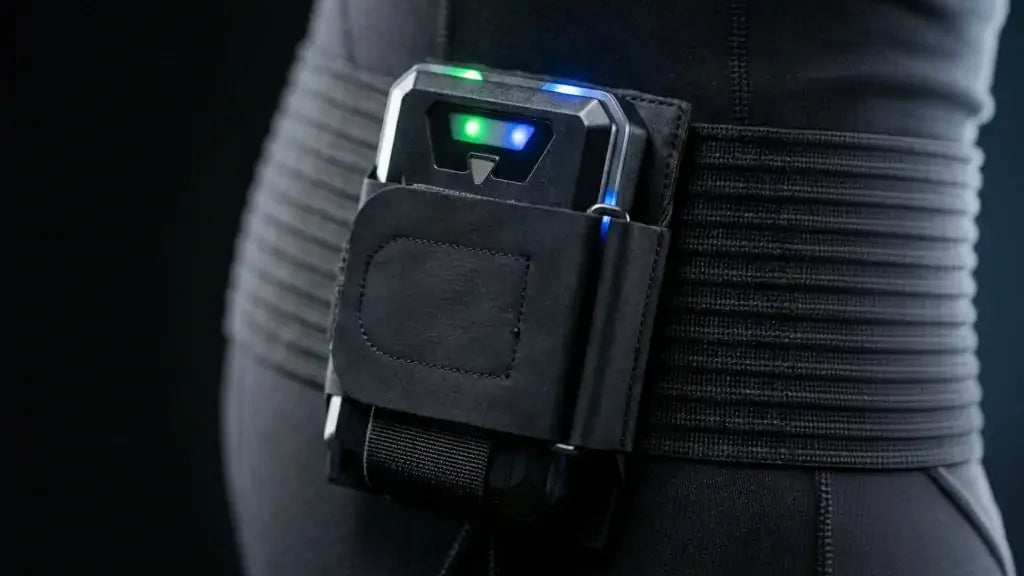
What you give up is real: the trainer's eye, the accountability of an appointment, and someone else owning your dose. Be conservative with the dial and you cover all three yourself. The Visionbody PowerSuit is what we recommend for solo training: 24 dry electrodes, a wireless PowerBox with a 3 year warranty, guided programs in the app, no subscription. Use code ROUTINES50 for $56.70 off, then start low and be patient.
How to pay for it
Visionbody lists the single system at $1,890 at the time of writing, down from $2,490. There are two ways to pay at checkout, plus a third that is worth reading carefully.
Pay in full. $1,890 today by card, Apple Pay or Google Pay.
Pay a deposit. $890 today secures the order and the remaining $1,000 is charged to the same card later. Visionbody says you get a notification before that second charge. Their own pages describe the balance as due on delivery in one place and due at shipping in another, so confirm the timing before you order. This is Visionbody's own payment schedule rather than a loan, so there is no lender, no interest and no credit check. For most people it is the sensible middle option.
Monthly instalments. The US checkout also offers Shop Pay Installments, which is credit from a lender and subject to an eligibility check. We are not quoting a monthly figure, because the plan you are offered depends on your own eligibility and the terms change. Read the sample plans at checkout properly before you commit, because the cheapest looking monthly payment is not the interest free one. Checking your eligibility does not affect your credit score. Rates from 0-36% APR. Payment options through Shop Pay Installments are subject to an eligibility check and are provided by these lending partners: affirm.com/lenders. A down payment may be required, and quoted payments exclude taxes and shipping.
routines.club is not a lender and does not arrange credit. Prices and payment options checked 3 August 2026 and subject to change.
More from our EMS hub
Frequently asked questions
Is EMS training safe to do at home without supervision?
It can be, if you respect the limits the format is built around. Every muscle group starts at level zero and gets raised individually, sessions stay at 20 minutes, and 48 hours sits between them. Those rules exist because excessive intensity carries a documented rhabdomyolysis risk. Anyone with a pacemaker or implanted device, pregnancy, epilepsy, a serious heart condition, active cancer or fever should avoid EMS entirely. This is general information, not medical advice.
Do you actually need a trainer to use an EMS suit?
No. Home systems are built for solo use, with a mandatory in app warm up and level control for each muscle group. A trainer's real value is calibration, showing you what a working level feels like against too much, in your first few sessions. If you can get two or three supervised sessions first, take them. This is general information, not medical advice.
How do you set the intensity right when nobody is watching?
Start every muscle group at zero and raise them one at a time, only after the warm up. You are aiming for a strong contraction you can still move and breathe through, not the highest number you can tolerate. Visionbody's heart rate guideline is 180 minus your age. If you cannot hold a movement or a sentence, come back down a level. This is general information, not medical advice.
How do you know if you have pushed too hard?
Normal is fatigue and some soreness for a day or two. The warning signs are soreness that keeps worsening past 48 hours, swelling, dark or cola colored urine, or feeling generally unwell after a session. That pattern points toward rhabdomyolysis, the documented risk from excessive EMS intensity, and it needs urgent medical attention rather than a rest day. This is general information, not medical advice.
Who should not train with EMS on their own?
Anyone the standard contraindications rule out, supervised or not. That means a pacemaker or any implanted electronic device, pregnancy, epilepsy, serious heart conditions, active cancer, fever, and open wounds or acute injury over the electrode areas. Whole body EMS is 18 and over only. If you have a condition you are unsure about, clear it with your doctor first. This is general information, not medical advice.
What technique mistakes do solo users make most?
Three come up repeatedly. Chasing the intensity number instead of the quality of the contraction. Adding weight or speed to movements meant to stay slow and simple, when the current is what supplies the overload. And skipping the warm up because the session is only 20 minutes long. Filming yourself on a phone is the cheapest substitute for a trainer watching your form.
How often can you do EMS at home on your own?
Visionbody's guidance is 20 minute sessions, two to three times per week, with 48 hours of rest between them. Research studies typically use 20 minute sessions once or twice a week. Training alone is not a reason to do more, and that 48 hour gap matters more when no trainer is tracking your load. This is general information, not medical advice.
Does FDA clearance mean an EMS suit is safe to use without a trainer?
It means the hardware passed a real regulatory review before it reached your door. Visionbody holds 510(k) clearance K222386, granted February 2023, free to look up in the FDA database. Clearance means the agency found the device substantially equivalent to a muscle stimulator already on the market. It's not an endorsement of results, and it doesn't replace the basics: starting every muscle group at zero, 20 minute sessions, 48 hours between. Training alone, that outside review is worth having, and worth asking any brand to show you by number.
Is a home EMS suit cheaper than studio sessions?
Substantially, if you train regularly. Sessions run $35 to $60 in the US and £55 to £60 in the UK, so twice a week at $40 is about $4,160 a year. A Visionbody PowerSuit at around $1,890, less $56.70 with code ROUTINES50, breaks even in roughly five to six months and then costs nothing. No app fee, and a household can share one suit.