Is EMS Training Safe? Side Effects and Who Should Avoid It
TL;DR
For healthy adults, whole-body EMS training is safe when it is properly guided and sensibly dosed. The technology recruits a lot of muscle at once, so the golden rule is to start slow, train with a qualified instructor, and let your body adapt. That said, there is a specific and published list of people who should skip EMS entirely. These are real contraindications, including a cardiac pacemaker, pregnancy, epilepsy, serious heart conditions, and acute illness. If any of those apply to you, EMS is off the table until a doctor clears you. Below we walk through why EMS stresses muscle differently, the side effects most people actually notice, the full list of who should avoid it, and the rules that keep the risk low.
A note before we start: this article is educational and is not medical advice. We are a training brand, not your physician. If you have any health condition, take regular medication, or feel unsure whether EMS is right for you, talk to your doctor before your first session. When in doubt, get cleared first.
Why EMS stresses your muscles differently
Regular strength training asks your brain to recruit muscle fibres gradually. You lift, your nervous system decides how many fibres to fire, and fatigue builds up as a natural brake. Whole-body electromyostimulation (WB-EMS) works around that brake. Electrodes stitched into a suit send an electrical impulse straight to the muscle, contracting many major muscle groups at the same time, including deep fibres that a beginner would struggle to activate voluntarily.
That is exactly why EMS is time-efficient, and also why you have to respect it. Because the stimulus is so complete, a single hard session can produce far more muscle damage than the same amount of time in a gym. The clearest marker of that damage is creatine kinase (CK), an enzyme that leaks into the blood when muscle tissue is stressed. Research summarised in a 2019 mini-review in Frontiers in Physiology shows CK levels after unaccustomed WB-EMS can climb far higher than after conventional exercise, typically peaking two to four days later.
In most people that CK bump is harmless and settles on its own. The concern is the extreme end. When muscle breakdown is severe enough, it becomes rhabdomyolysis, a condition where muscle contents flood the bloodstream and can overwhelm the kidneys. This is not hypothetical. Kästner, Braun and Meyer (2015, Clinical Journal of Sport Medicine) documented two young professional soccer players who developed rhabdomyolysis after a single EMS session, one with a peak CK of 240,000 U/L, roughly a thousand times the normal upper limit. The lesson those authors drew is blunt: EMS should not be the first or only training method for a beginner, and an unaccustomed session at high intensity can harm even elite, well-conditioned athletes.
This is the single most important thing to understand about EMS safety. The danger is almost never one careful session. It is doing too much, too soon, too often. That is why every credible guideline insists that newcomers start with a low dose and build up slowly over weeks, not days.
The side effects most people actually notice
For the average healthy adult who trains sensibly, the side effects of EMS are minor and short-lived. The two you are most likely to meet are muscle soreness and skin irritation.
Delayed muscle soreness. Because EMS reaches fibres your normal workouts might miss, the soreness after your first few sessions can be noticeable. It behaves like classic delayed onset muscle soreness (DOMS), arriving a day or two after training and easing within 48 to 72 hours. Mild soreness is expected and is part of adapting. Soreness that is severe, that comes with unusual weakness, or that shows up alongside dark, cola-coloured urine is a different story and needs medical attention, because those can be warning signs of excessive muscle breakdown.
Skin irritation. The electrodes sit against damp skin, and some people get temporary redness or itching where the pads make contact. It is usually caused by the moisture, the pressure, or a reaction to the electrode material rather than the current itself. Clean skin, a properly fitted suit, and correctly dampened electrodes keep this to a minimum. Persistent rashes or broken skin mean you should pause and let the area heal.
Other occasional, transient effects include a tingling sensation during stimulation and mild muscle cramping. These typically fade as your body gets used to the modality. The through-line is simple: normal EMS side effects are mild and temporary. Anything intense, spreading, or lingering is your cue to stop and check in with a professional.
Who should avoid EMS training
This is the part to read carefully. Because EMS drives a strong electrical current through a large part of the body, several medical conditions make it genuinely unsafe. The list below follows the evidence-based German consensus recommendations published by von Stengel and colleagues (2024, Frontiers in Sports and Active Living), which updated the earlier Kemmler et al. (2019) guidance. These are the standards that reputable studios screen against.
Absolute contraindications (do not train)
- A cardiac pacemaker, implanted defibrillator, or any other electrical implant
- Heart arrhythmia or other serious cardiac conditions
- Pregnancy
- Epilepsy and other neurological or neuronal disorders
- Severe bleeding disorders or a tendency to bleed, such as haemophilia
- Acute illness, fever, bacterial infections, or active inflammatory processes
- Arteriosclerosis or arterial circulation disorders
- Stents or bypasses that have been in place for less than six months
- Untreated high blood pressure (hypertension)
- Abdominal wall or inguinal hernia
- Being under the acute influence of alcohol, drugs, or other intoxicants
- Recent surgery in the areas the electrodes would cover
Relative contraindications (only with medical clearance)
- Diabetes mellitus (type 1 or type 2)
- Tumours or cancer
- Diseases of the internal organs, particularly kidney disease
- Other cardiovascular disease
- Acute back pain without a diagnosis, acute neuralgia, or herniated discs
- Implants that have been in place longer than six months
- Significant fluid retention or oedema
- Open skin injuries, wounds, eczema, or burns near the electrode sites
A quick note on the relative list. In the 2024 revision, diabetes and cancer were moved from the absolute category to the relative one after a review of the evidence. That does not mean they are cleared for a walk-in session. It means training may be possible under medical supervision and individual assessment, never on your own judgement. If any item on either list applies to you, the honest answer is the same: do not book an EMS session until a doctor who knows your history says it is safe.
The safety rules that keep EMS low-risk
Screening tells you whether you can train at all. These rules keep the training itself safe once you are cleared. They come straight from the international position statement by Kemmler and colleagues (2023, Frontiers in Physiology).
Start with one session per week. The guideline is explicit: during the first eight to ten weeks, cap yourself at a single 20-minute WB-EMS session per week, and keep the intensity modest, around a "somewhat strong" feeling rather than all-out. Your first session should include a few minutes of low-intensity familiarisation before anything harder. This slow ramp is the main defence against the CK spikes and rhabdomyolysis cases described above.
Leave real recovery between hard sessions. Because CK peaks days after training, the same guideline recommends at least a four-day gap between intense EMS sessions so muscle has time to recover instead of stacking damage on damage.
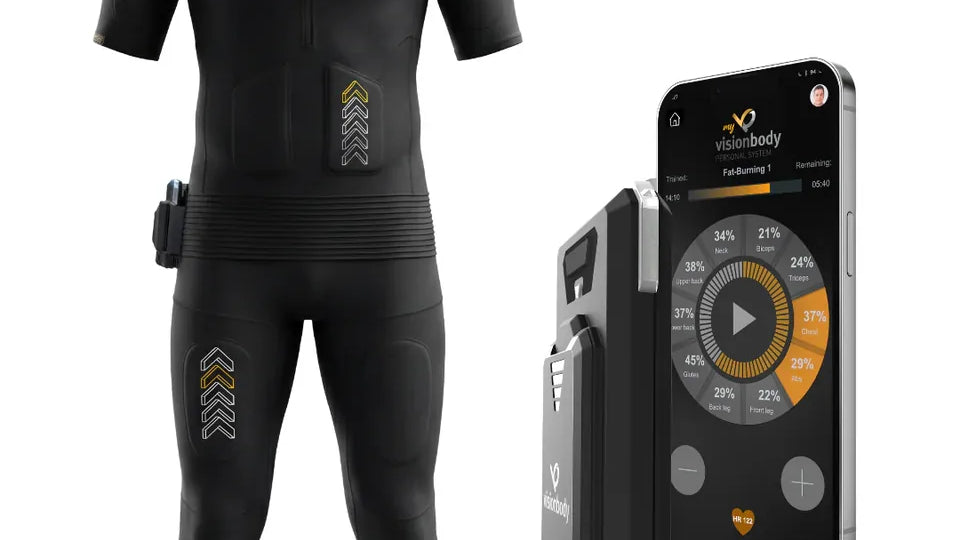
Train under qualified, licensed supervision. EMS is not a plug-in-and-go home gadget for beginners. The position statement calls for trainers with dedicated WB-EMS education and close, one-to-one or one-to-two supervision that keeps you in view and within reach throughout the session. A good instructor sets the intensity conservatively, watches how you respond, and dials things back when needed. Training on certified equipment with a properly trained coach, for example a supervised session in a Visionbody EMS suit, is a large part of what separates safe EMS from risky EMS. If you decide a home suit is right for you, the Visionbody uses app controlled intensity so you can start low and build up gradually, and code ROUTINES50 takes $56.70 off.
Hydrate before and after. Good hydration supports the kidneys as they clear the by-products of muscle work. The guideline suggests drinking roughly 250 to 500 ml of fluid before and after training. Turning up dehydrated, hungover, or after a night of poor sleep is exactly the wrong way to meet a high-intensity stimulus.
Do not chase intensity. The instinct to push the dial higher every week is what got those soccer players into hospital. More is not better with EMS. Progress the intensity gradually, respect the soreness, and never train through a fever or an illness.
For what the soreness and the intensity actually felt like across thirty-plus sessions, our three month log is a first-person account rather than a summary of the literature.
The bottom line
Is EMS training safe? For a healthy adult who has been screened, trains with a qualified instructor, and follows a sensible progression, yes, it has a good safety profile and the side effects are usually limited to some soreness and the odd bit of skin redness. The risks that make headlines, above all rhabdomyolysis, come almost entirely from overdoing it: too much intensity, too soon, without supervision. Treat EMS with the same respect you would give a heavy barbell and it rewards you with an efficient workout. Treat it casually and it can bite.
And the part worth repeating: EMS is genuinely not for everyone. If you have a pacemaker, are pregnant, have epilepsy or a serious heart condition, or are acutely unwell, this is not your training method, full stop. For everyone in a grey area, the safe move is boring and correct, which is to ask your doctor first.
This article is for general education only and does not replace professional medical advice, diagnosis, or treatment. Always consult a qualified healthcare provider before starting EMS training, especially if you have any pre-existing condition or concern.
More from our EMS hub
Frequently asked questions
Who should not use an EMS suit?
Skip whole body EMS entirely if you have a pacemaker or any implanted electronic device, if you are pregnant, or if you have epilepsy, a serious heart condition, active cancer or a fever. The same applies to open wounds or an acute injury under the electrode areas. Suits like Visionbody are adults only, 18 and over. If you are unsure where you sit, ask your doctor before a first session. This is general information, not medical advice.
Can EMS training really cause rhabdomyolysis?
Yes, and it is the one risk worth taking seriously. Excessive intensity, especially in a first session or after a long break, can break muscle tissue down faster than the body clears it. That is why the protocol exists: 20 minute sessions, every muscle group starting at level 0, and 48 hours between sessions. Very dark urine, extreme soreness or swelling needs medical attention, not a rest day. This is general information, not medical advice.
What are the normal side effects of EMS, and when should I worry?
Ordinary soreness for a day or two is normal, especially after your first few sessions, and it usually feels deeper than gym soreness. Mild skin redness where the electrodes sit is common too. What is not normal is dark urine, soreness that keeps getting worse past 48 hours, swelling, or feeling unwell. Stop and get it checked rather than training through it. This is general information, not medical advice.
How often can a beginner safely do EMS?
Do one session and see how you feel over the next two days before booking another. Visionbody recommends 20 minute sessions, two to three times a week, with 48 hours between them, and beginners belong at the bottom of that range. Keep the intensity low on early sessions even if it feels easy, because soreness from EMS shows up late. This is general information, not medical advice.
Is it safe to do EMS if I have high blood pressure?
High blood pressure is not on the standard whole body EMS exclusion list, which covers pacemakers and implanted devices, pregnancy, epilepsy, serious heart conditions, active cancer, fever, and open wounds over the electrodes. That is not the same as a green light. Sessions raise heart rate, and the usual guideline is to stay under 180 minus your age. Ask your doctor before you start. This is general information, not medical advice.
Do you need medical clearance before starting EMS?
Not everyone does, but it depends on your history. If you take medication for your heart or blood pressure, have any implanted device, are pregnant, or are recovering from an injury, get cleared first. If you are a healthy adult with none of that, the built in controls carry more weight: a mandatory warm up, every group starting at level 0, and 48 hours between sessions. This is general information, not medical advice.
Is a home EMS suit as safe as a supervised studio session?
It can be, but the safeguards shift onto you. A studio trainer caps the intensity and reads your form. At home the equivalents are the app's mandatory warm up, starting every muscle group at level 0, keeping sessions to 20 minutes, and leaving 48 hours between them. The risk with home use is not the hardware, it is the temptation to push the dial. This is general information, not medical advice.
Can under 18s use an EMS suit?
No. Visionbody sells to adults only, 18 and over, and that is the standard position across whole body EMS. It is worth saying plainly, because a suit bought for one adult in the house tends to get shared around. The age limit is set by the manufacturer, and the same contraindications apply to everyone else in the household. This is general information, not medical advice.
Is a home EMS suit regulated, or can anyone put one on the market?
It's a regulated category in the US, and not every brand can show it cleared the bar. Visionbody holds FDA 510(k) clearance K222386, granted February 2023, listed as a Class II powered muscle stimulator for muscle conditioning. Clearance means the FDA found the device substantially equivalent to one already on the market, so it's a hardware review, not a promise about your results. We searched the database under TitanBody and SQAI, plus their known parent names, and found nothing, so ask them for a number. Visionbody's takes a minute to check.