EMS vs Weight Training: Which Builds More Muscle?
TL;DR
If your only goal is the most muscle and the most strength you can possibly build, traditional resistance training is still the gold standard, and nothing has dethroned it. Progressive overload with barbells, dumbbells, and machines gives you the mechanical tension and long-term progression that drive maximal growth. Whole-body EMS is not a magic shortcut that beats the barbell. What it is, backed by real research, is a genuinely time-efficient way to get meaningful strength and muscle gains in about 20 minutes a session, which makes it a strong option for busy people, older or deconditioned adults, and anyone who wants to complement their lifting. The honest answer to "which builds more muscle" is that heavy lifting wins at the ceiling, EMS wins on the clock, and for a lot of people the smartest move is to use both.
Related: the EMS workout plan by level →
What the research actually shows
Let us start with why lifting is the benchmark. Decades of exercise science point to mechanical tension as the primary driver of muscle growth, applied through progressive overload, gradually asking the muscle to handle more over time. That framework is laid out clearly in Schoenfeld's review (2010, Journal of Strength & Conditioning Research). Free weights let you load a movement heavily and keep adding load for years, which is exactly the stimulus hypertrophy responds to. This is why resistance training remains the reference every other method gets measured against.
So how does EMS measure up when you put the two head to head? Better than a lot of lifters expect. In a 16-week randomised controlled trial, Kemmler and colleagues (2016, Evidence-Based Complementary and Alternative Medicine) compared whole-body EMS against high-intensity resistance training in untrained men aged 30 to 50. The EMS group trained for 20 minutes, roughly three sessions every two weeks. The result was striking: both groups improved lean body mass, leg strength, and body fat with no statistically significant difference between them. The authors concluded that WB-EMS is a "time-efficient but pricy option" to conventional resistance exercise for improving strength and body composition.
Zoom out from a single study and the picture holds. A systematic review and meta-analysis by Kemmler and colleagues (2021, Frontiers in Physiology) pooled 16 controlled trials covering 897 participants. It found large, significant effects of WB-EMS on muscle mass and strength, with an average lean mass gain of around 0.9 kg. The authors noted that figure sits "in line with" the roughly 1.1 kg typically reported for conventional resistance exercise. In other words, for the populations studied, EMS produces muscle and strength gains in the same ballpark as lifting.
Here is the important honesty check. Almost all of that supportive evidence comes from untrained, middle-aged, or older adults. For people who are already well trained, the case for EMS as a muscle builder is much weaker. A 2024 systematic review in the German Journal of Sports Medicine looking at active young adults found the performance benefits far less consistent than in beginner populations. That makes sense. EMS is very good at getting a lot of muscle activated when someone cannot yet do that on their own, but a trained athlete can already recruit their muscle fibres hard through heavy lifting, so the extra stimulus adds less. If you are a seasoned lifter chasing your next size ceiling, run EMS alongside your lifting: it adds stimulus without adding hours.
The time economics: 20 minutes vs an hour
This is where EMS earns its reputation, and it is a real advantage, not marketing. A whole-body EMS session is about 20 minutes of actual stimulation. A comprehensive resistance-training session, once you include a warm-up, several exercises, multiple working sets, and the rest periods between them, usually runs 45 to 75 minutes, and that is before you factor in the commute to a gym.
Think about the weekly maths. Two proper gym sessions can easily eat two to three hours. Two EMS sessions might cost you 40 minutes of training time. For someone with a packed calendar, that difference is often what decides whether they train consistently or not at all, and consistency beats theoretical optimality every single week. The Kemmler 2016 trial is the proof of concept: the EMS group reached comparable results in a fraction of the in-session time.
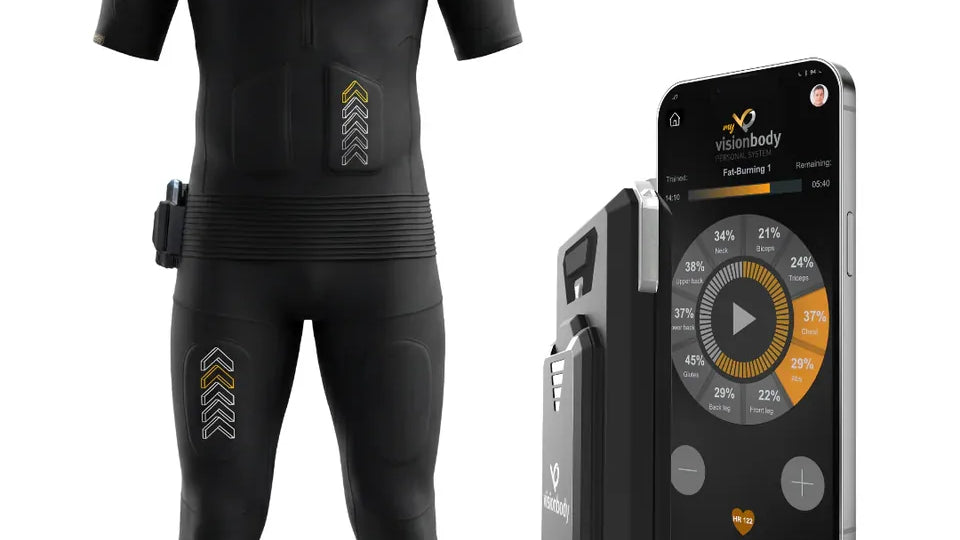
There are two honest caveats to keep the comparison fair. First, EMS requires supervision and equipment, which is why the researchers repeatedly call it "pricy" next to a barbell you can use for decades. Second, the time saving is real but it is not free efficiency with no downside, because you give up the heavy external loading and skill development that lifting builds. What you buy with EMS is time. What you pay is money and some of the specificity of the barbell. For the right person, that is a trade well worth making. Modern systems such as the wireless Visionbody EMS suit are built around exactly this promise of a full-body session in about 20 minutes.
Who should pick which
There is no universal winner here, only a best fit for your situation.
Pick traditional weight training if your primary goal is maximal muscle size or maximal strength, you enjoy the process of lifting, you want to build a skill you can progress for years, or you are already a trained athlete. Nothing substitutes for putting progressively heavier loads through full ranges of motion. If you want to be as big or as strong as your genetics allow, the barbell is home base.
Lean toward EMS if time is your hard constraint, you are returning to training after a long break, you are older or deconditioned and find heavy loading intimidating or joint-unfriendly, or you simply want a full-body stimulus you can finish in 20 minutes. The research is clearest and most favourable for exactly these groups. EMS is also low-impact on the joints, which appeals to people managing wear and tear who still want to challenge their muscles.
Either can work if your goal is general fitness, body recomposition, or staying strong and healthy. Both methods improve lean mass and strength for non-athletes. In that case, pick the one you will actually keep doing, because adherence is the real active ingredient.
The hybrid approach most people overlook
The "versus" framing sells clicks, but it hides the smartest option: use both. EMS and lifting are not rivals fighting over the same muscle, they are two tools with different strengths.
A practical hybrid looks like this. Keep resistance training as your foundation for the sessions where you have time, since that is where you build heavy strength, movement skill, and the highest ceiling for growth. Then use EMS to plug the gaps: a 20-minute full-body session on a busy week when the gym is not happening, an extra weekly stimulus without piling more heavy joint load onto your body, or a way to keep training when you are travelling. You get the long-term progression of the barbell and the time-efficiency of EMS, instead of forcing yourself to choose.
This is also the most sustainable answer for people whose lives are not built around the gym. Two lifting sessions plus one EMS session a week is a realistic, low-friction routine that still hits every major muscle group hard. If you want to try building EMS into your week, our readers can use the code ROUTINES50 for $56.70 off to get started with Visionbody, then slot it around the lifting you already do.
Whichever mix you choose, the same rules from good training still apply. EMS is a strong stimulus, so start with one session a week, progress gradually, and give yourself real recovery between hard efforts. Doing more of it, faster, does not build more muscle. It just builds more fatigue.
The bottom line
Which builds more muscle, EMS or weight training? At the absolute ceiling, traditional resistance training wins, and the science on mechanical tension and progressive overload is not close to being overturned. But that is not the question most people are really asking. If your question is "can I get meaningful muscle and strength in 20 minutes a session," the honest, research-backed answer is yes, especially if you are not already a highly trained lifter. Heavy lifting is the gold standard for maximal results. EMS is the efficient path to very good results in a fraction of the time. The two are complements more than competitors, and the person who uses both intelligently usually comes out ahead of the person still arguing about which one is best.
More from our EMS hub
Frequently asked questions
How much muscle can you build with EMS?
Whole body EMS builds muscle most convincingly in beginners and in people returning after a break, which is exactly who most home suit buyers are. Twenty minutes two to three times a week is enough stimulus to drive that adaptation. Used alongside resistance training it adds a second quality stimulus in a fraction of the time, which is why most owners run both.
Is 20 minutes of EMS really enough?
Enough for what it is, yes. A 20 minute whole body session drives 12 channels across 24 electrodes at once, so you are not working one muscle group at a time the way a gym session does. That density is why the protocol is only two to three sessions a week with 48 hours between them. It is not that 20 minutes equals an hour of lifting. It is a different stimulus.
Can I combine EMS and weight training?
Yes, and that is the setup that makes most sense. Keep lifting for progressive load, and use EMS as extra weekly stimulus. The one rule is spacing: leave 48 hours between EMS sessions, and do not stack a hard EMS session straight onto a heavy leg day, because the soreness compounds and shows up late. Two to three EMS sessions a week fits around most lifting splits.
Can EMS help with fat loss?
It helps by building and holding muscle, which supports your metabolism, and the deficit still comes from what you eat. The practical advantage is adherence. Twenty minutes two to three times a week is a commitment most people actually keep, and the plan you keep is the one that changes your body.
Can you train with EMS alone, without a gym?
Yes. For someone without gym access it is a real training stimulus delivered in 20 minutes at home, and beginners and returners see the strongest results. If you also lift, running both gives you the best of each: progressive load from the bar and a short high recruitment session from the suit.
Does an EMS session count as conditioning?
Your heart rate does climb during a session, with the usual guideline being to stay under 180 minus your age, so think of it as strength focused work that also raises your pulse. Keep your walking, running or cycling alongside it and you cover both bases in very little total weekly time. This is general information, not medical advice.
Does EMS make you stronger, or just more toned?
Strength does improve, mainly in beginners and returners, because a contraction driven by current still recruits muscle. Where it lags is loaded strength, since getting stronger at squatting or pressing needs the actual movement under actual load. Toned is mostly a body composition word anyway. If you want a number on a bar to go up, EMS supports that goal rather than delivering it.
Is an EMS suit a regulated device in a way gym weights are not?
A barbell needs no clearance. A device that sends current through your muscles does, and Visionbody has one: 510(k) number K222386, cleared February 2023 as a Class II powered muscle stimulator for muscle conditioning. Clearance means the FDA found it substantially equivalent to a device already on the market. It isn't a promise that EMS beats lifting or delivers any result. It is a real review, free to check in the FDA database, sitting behind a stimulus you run at home alongside your training.
Does EMS build as much muscle as lifting weights?
For untrained and older adults, the research is encouraging. Kemmler and colleagues (2016, Evidence-Based Complementary and Alternative Medicine) found comparable gains in lean mass and strength between WB-EMS and high-intensity resistance training over 16 weeks, and a 2021 meta-analysis reported EMS lean mass gains in line with conventional lifting. For already-trained athletes, though, heavy resistance training remains superior for maximal growth.
Which is better for fat loss, EMS or weights?
Neither is a strong fat-loss tool on its own. The 2021 meta-analysis found EMS had no significant effect on body fat, and the same is broadly true of resistance training without a supporting diet. Fat loss is driven mostly by nutrition and overall energy balance. Both EMS and weights help by building and preserving calorie-hungry muscle, but the kitchen does most of the work.