Visionbody vs Katalyst: Which EMS Suit Should You Actually Buy?
Last updated July 2026. We may earn a commission if you buy through links on this page. That never changes our verdict, and we call out the weak spots on both suits below.
Related: our Visionbody discount code and full pricing →
Also new: Visionbody vs TitanBody →
If you are shopping for a whole body EMS suit to use at home, your shortlist almost certainly comes down to two names: Visionbody and Katalyst. We have spent weeks digging through spec sheets, owner forums, Trustpilot pages and long term reviews of both systems, and the short answer is this: for most people, Visionbody is the better buy. It is ready to wear in seconds instead of minutes, it reaches muscle zones Katalyst does not touch, and because there is no subscription it costs roughly $1,900 less to own over three years.
That said, this is not a blowout. If you want a trainer on screen telling you exactly what to do, buy Katalyst. Its app is the best in the category by a wide margin, with a large library of video guided workouts that Visionbody simply does not have. Katalyst was also the first whole body EMS suit cleared by the FDA for home use, a point covered in Today's hands-on review, and reviewers consistently praise how polished the experience feels.
Below is the full comparison: real prices, the three year cost math, setup, muscle coverage, apps, and what actual owners are saying in 2026.
Visionbody vs Katalyst at a glance
| Visionbody Ultimate | Katalyst Gen 4 | |
|---|---|---|
| Hardware price | $2,490 list, often on sale for $1,890 | $2,999 |
| Subscription | None, app and programs included | Required, $35 to $49 per month depending on commitment |
| Three year cost | About $2,490 | About $4,439 |
| Electrode system | 24 dry electrodes, 12 channels, no wetting | 26 wet electrode pads, spray before every session |
| Coverage | Full bodysuit incl. shoulders, inner thighs and calves | Vest, shorts and arm straps; no calves or shoulders |
| Setup time | Under a minute, slip on and go | Roughly 5 minutes once practiced |
| App | iOS and Android, self directed programs | iOS only (iOS 16+), 120+ video guided workouts |
| Regulatory | FDA cleared, TUV certified | FDA cleared for home use |
| Pedigree | German engineered, company founded 2014 | US brand, launched off a 55,000 person waitlist |
Price and ownership cost: Visionbody wins, and it is not close
Sticker prices only tell half the story here. On the official Katalyst store, the Gen 4 Training System sells for $2,999, and a membership is required with your initial purchase to use the suit at all. That membership runs $49 per month on the flexible plan, $41 on an annual plan, and drops to $35 only if you commit for three years. Call it roughly $40 a month in practice.
Run the three year math and the gap gets uncomfortable. Katalyst costs $2,999 up front plus about $40 times 36 months, which is another $1,440 in fees. Total: about $4,439 over three years, and the meter keeps running after that. Visionbody's Ultimate system lists at $2,490 flat on the official Visionbody store, with the app, training programs, PowerBox control unit and battery all included. No membership, ever. That is a difference of roughly $1,900 over three years, and it grows every month you keep training.
It gets better if you catch a promotion, and Visionbody runs them often. At the time of writing the Ultimate system is marked down to $1,890, and you can stack our discount: use code ROUTINES50 for $56.70 off at the Visionbody store for $56.70 off your suit.
One more ownership cost worth knowing. The 2026 roundup at Outliyr documents Katalyst owners being quoted $1,299 for a replacement impulse pack once the built in battery dies out of warranty. Visionbody's PowerBox runs on a removable LP-E10 battery, the same style used in entry level Canon cameras, so a spare costs pocket change and swaps in seconds.
Setup and comfort: dry beats wet for daily use
This is the difference you will feel every single session. Katalyst is a wet electrode system. Before each workout you put on a base layer and thoroughly spray it down with water so the 26 pads conduct properly, then pull the vest, shorts and arm straps over it. Outliyr's reviewer, who logged 137 workouts in the suit, says his first setup took 25 minutes and settled at about 5 minutes with practice. He also describes the most annoying failure mode: you get fully suited up, the app flags a pad that is not wet enough, and you have to peel everything off to re-wet it. Base layers come out soaked after every session, and Katalyst only includes two, so laundry becomes part of your training plan.
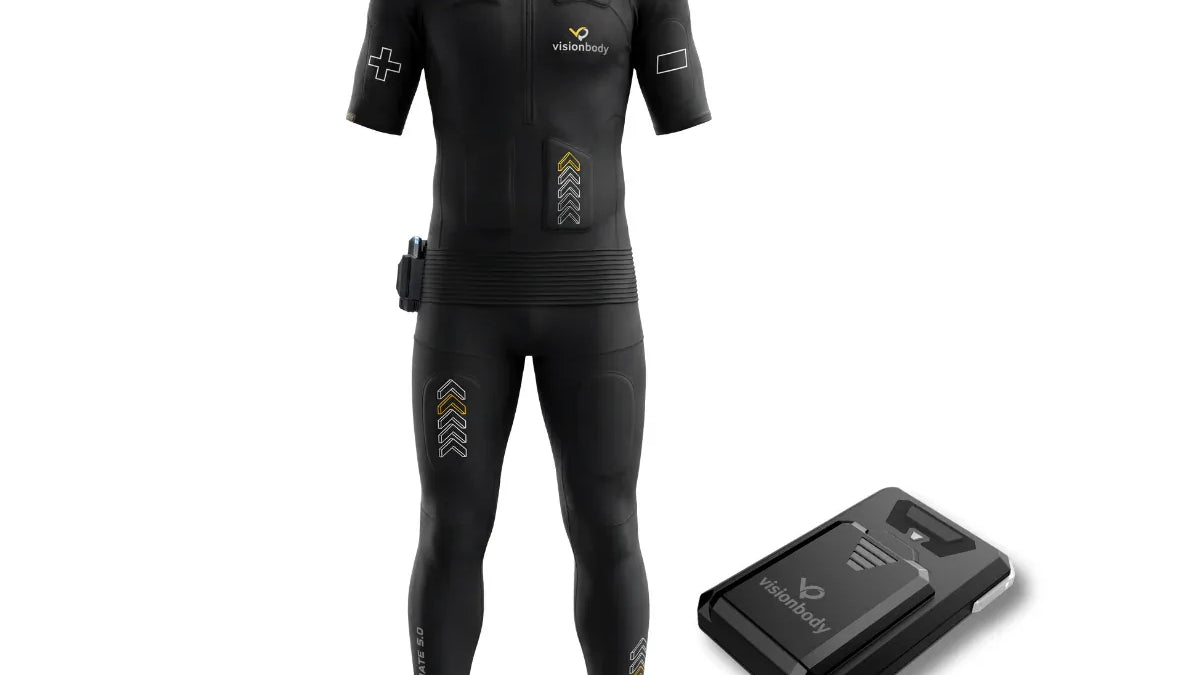
Visionbody went the other way. Its PowerSuit uses 24 dry electrodes woven into a single zip up suit, so there is no spraying, no gel and no base layer. You slip it on like a wetsuit and start training in well under a minute, and the suit itself is machine washable with a wash recommended every three to four sessions. For anyone squeezing EMS into a lunch break, that convenience gap is the whole ballgame.
In fairness, wet electrodes exist for a reason. Soaked pads conduct beautifully from the first second, and Outliyr credits Katalyst with strong, even, full body activation. Dry electrodes rely on skin contact and get better as you warm up and sweat. Owners on both sides report powerful sessions, but if you train in a cold, dry room, expect the first few minutes on a dry suit to feel gentler until your skin does its part.

Muscle coverage: Visionbody reaches zones Katalyst skips
Raw electrode counts are nearly a tie, and honestly Katalyst has more: 26 pads versus Visionbody's 24. What actually separates them is where those electrodes sit.
Katalyst splits its coverage across a vest, shorts and arm straps. Per Today's review, you can set intensity for quads, hamstrings, glutes, abs, lower back, middle back, upper back, chest and arms, with 13 body sections stimulated at once. Notice what is missing: nothing below the knee, and no shoulder coverage.
Visionbody's Ultimate PowerSuit is a true full bodysuit, and its 24 electrodes extend to shoulders, inner thighs and calves on top of the usual chest, back, core, glute and thigh zones, with each of its 12 channels individually adjustable. If you care about complete leg development, run related calf work, or shoulder and neck tension, Visionbody is the only one of the two that gets there. The trade going the other way: Katalyst's arm straps hit biceps and triceps directly, which Visionbody's sleeveless suit does not.
Tinkerers should also note the stimulation specs. The EMS educators at Conrad EMS Fitness point out that Katalyst caps strength work at 75 Hz with a 105 Hz maximum, while Visionbody runs up to 100 Hz in its low frequency mode and offers a 2,000 Hz mid frequency mode. Most beginners will never touch those ceilings. Experienced EMS users will.

App and training content: Katalyst wins, clearly
If the app is the deciding factor for you, read is Katalyst worth it before you commit, because the membership that funds that app is not optional and what the Katalyst membership really costs over five years is the number most buyers never run. If it is not, the no subscription alternatives to Katalyst is the shorter read.
Credit where it is due: Katalyst's app is the best reason to buy the suit, and it is not a small reason. The library holds over 120 workouts across strength, power, cardio and recovery modes, all video guided by professional trainers who cue every movement while the suit's stimulation syncs to the work and rest intervals. Outliyr's long term reviewer calls the interface a big difference maker in EMS training, and after 137 workouts he still praised the coaching quality. If you have never trained with EMS before, this is the closest thing to having a studio trainer in your living room. This is what the monthly fee funds, and for guided workout lovers it is genuinely worth it.
Two caveats. First, the app requires an iPhone or iPad running iOS 16 or later, so Android users are locked out entirely. Second, the content lives behind that mandatory membership, so stop paying and your $2,999 suit loses most of its brain.
Visionbody's app, on iOS and Android, is a control panel more than a coach. You pick a program (strength, cardio, relax and so on), set per channel intensities, and do your own thing: squats, band work, a walk, whatever you like. Conrad EMS Fitness notes that Visionbody lacks an official video workout library, though one has reportedly been in development. We think that is the honest weak spot in an otherwise stronger package. If you need structure handed to you, you will feel the gap.
What owners actually say
We are owners too. Three months with the Visionbody, including the settings we ended up using and what we would do differently.
Neither company walks away clean here, and you should know both stories before spending this kind of money.
Katalyst's hardware earns consistent praise, but its 2025 was rough. Reddit threads collected in Outliyr's 2026 roundup describe months of unanswered support tickets, support team layoffs, delayed Gen 4 shipments and unfulfilled refund requests. One owner reported being told the company was not responsible for suits purchased before its ownership change. Combined with the $1,299 impulse pack replacement quotes, the pattern that worries us is simple: this is subscription hardware from a company that has struggled to answer its customers.
Visionbody holds a 4.7 out of 5 rating from over 300 reviews on Trustpilot, with owners praising results, comfort and the no fuss dry design. It is not spotless either. Some 2025 buyers reported long shipping delays, including one order placed in July that had not arrived by November, with tariffs blamed, and support responsiveness gets mixed marks. The difference is what happens if support goes quiet: a Visionbody suit keeps working forever because nothing about it depends on a subscription server or a locked in battery pack.
Which one should you buy?
The busy professional: Visionbody. If your workout window is 20 minutes between meetings, the dry suit is the entire decision. No spraying, no soaked base layers in the laundry basket, no membership to manage. Zip in, train, zip out. Grab it through our Visionbody link and use code ROUTINES50 for $56.70 off.
The data nerd: Visionbody. Twelve individually controllable channels, wider frequency ranges, calf and shoulder zones to program, and no content paywall deciding what your hardware is allowed to do. Katalyst tracks streaks and progress nicely in its app, but Visionbody hands you the actual dials.
The guided workout lover: Katalyst. If you know you will skip sessions without a trainer counting you down, buy Katalyst and do not feel bad about it. The 120+ workout library is the best training content in EMS, the FDA cleared hardware is excellent, and the structure is worth the fee to the right person. Just go in with open eyes about the $4,400+ three year cost, the iOS requirement and the support track record, and buy from the official Katalyst store with a credit card that has purchase protection.
Our bottom line: Katalyst is the better fitness studio, Visionbody is the better product to own. Since most people buying a $2,000+ EMS suit plan to use it for years, we recommend Visionbody for most readers. Code ROUTINES50 takes $56.70 off, and stacked on the current $1,890 sale price it lands the suit at well under half of Katalyst's three year cost.
How to pay for it
Visionbody lists the single system at $1,890 at the time of writing, down from $2,490. There are two ways to pay at checkout, plus a third that is worth reading carefully.
Pay in full. $1,890 today by card, Apple Pay or Google Pay.
Pay a deposit. $890 today secures the order and the remaining $1,000 is charged to the same card later. Visionbody says you get a notification before that second charge. Their own pages describe the balance as due on delivery in one place and due at shipping in another, so confirm the timing before you order. This is Visionbody's own payment schedule rather than a loan, so there is no lender, no interest and no credit check. For most people it is the sensible middle option.
Monthly instalments. The US checkout also offers Shop Pay Installments, which is credit from a lender and subject to an eligibility check. We are not quoting a monthly figure, because the plan you are offered depends on your own eligibility and the terms change. Read the sample plans at checkout properly before you commit, because the cheapest looking monthly payment is not the interest free one. Checking your eligibility does not affect your credit score. Rates from 0-36% APR. Payment options through Shop Pay Installments are subject to an eligibility check and are provided by these lending partners: affirm.com/lenders. A down payment may be required, and quoted payments exclude taxes and shipping.
routines.club is not a lender and does not arrange credit. Prices and payment options checked 3 August 2026 and subject to change.
More from our EMS hub
Frequently asked questions
Which is cheaper long term, Visionbody or Katalyst?
Visionbody, and the gap widens every month. Katalyst is $2,999 up front plus a mandatory $35 to $49 per month for as long as you keep training. Visionbody is $1,890, with ROUTINES50 taking $56.70 off, and there's no subscription at any point. Even allowing for a $489 replacement suit down the line, the recurring fee is what decides this comparison.
Is the Katalyst subscription really mandatory?
Yes. The $35 to $49 monthly fee is part of the Katalyst product rather than an optional coaching extra, so the suit's usefulness stays tied to an active payment. That's the single biggest structural difference between the two systems. Visionbody's app is free on iOS and Android with no subscription, so a six month break from training costs you nothing at all.
Does Katalyst have more electrodes, and does it matter?
Katalyst has 26 electrodes against Visionbody's 24, so the coverage difference is small. Channels matter more than pad count, because channels are what you control independently. Visionbody splits into 12 channels, each raised from level 0 on its own during the warm up, which is what lets you push glutes hard while keeping abs light. Two extra pads won't change how a session feels.
Does either suit need water or conductive gel before a session?
Visionbody's 24 electrodes are dry. Nothing to spray, dampen or gel, which is why setup is quick and a thin seamless layer underneath is all you need. Wet systems, and SQAI at $2,795 is the clearest example, add a preparation step to every single session and push more moisture through the fabric. Confirm Katalyst's current requirement with Katalyst directly, because it changes what a session costs you in time.
Can I use Katalyst on an Android phone?
No. Katalyst is iOS only, which quietly rules it out for a lot of buyers. Visionbody's app is free on both iOS and Android and connects to the PowerBox over Bluetooth. If you're on Android and Katalyst is your first choice, the true cost includes a new phone, so weigh that against a $2,999 suit and $35 to $49 every month.
Are Visionbody and Katalyst FDA cleared?
Both are. Visionbody holds 510(k) number K222386, cleared in February 2023 under VB Technologies AG as a Class II powered muscle stimulator for muscle conditioning. Katalyst holds K171035 and K181199 for its Mark 1 system. You can look either up for free in the FDA 510(k) database. Clearance means the device was found substantially equivalent to one already on the market. It is not an FDA endorsement of any fitness result.
Does the Visionbody suit require a subscription?
No. The Visionbody app, training programs, PowerBox control unit and battery are all included in the one time purchase, on both iOS and Android. Katalyst requires a paid membership from day one, between $35 and $49 per month, and its guided workout library stops working if you cancel.
Do you really have to wet the Katalyst suit before every workout?
Yes. Katalyst uses wet electrodes, so you spray down the base layer thoroughly before every session, and the app will flag pads that are too dry, sometimes after you are already suited up. Visionbody uses dry electrodes, so you just put the suit on and start, with no water, gel or base layer involved.