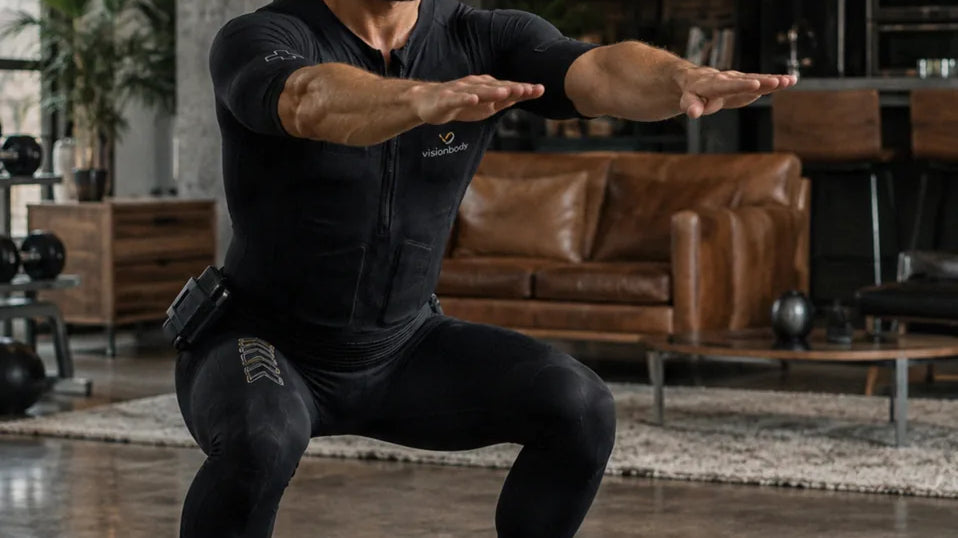
Your first EMS session isn't a workout, it's a calibration session. A mandatory in-app warm up runs, then every muscle group starts at zero and you raise each one until the contraction is clear and your form still holds. Everything after that is repetition: 20 minute sessions, two or three a week, at least 48 hours apart. The encouraging part: the research on whole body EMS is strongest in beginners, which is exactly where you're standing.
Calibration takes a few sessions to settle. Our three month account lists the levels one person ended up on for each muscle group, which is a useful sanity check when you are starting from zero.
Why beginners get the most out of EMS
The whole body EMS literature, led largely by Kemmler and von Stengel, keeps landing on the same finding: the effect is clearest in people who are untrained or returning after a long gap. Being new is the advantage here.
Two details shape the plan below. Studies typically use 20 minute sessions once or twice a week, far less volume than beginners expect to need. And EMS supplements training rather than replacing progressive resistance work. Read it yourself on PubMed.
Who should not train with EMS
Some people should not use whole body EMS at all. Avoid it with a pacemaker or any implanted electronic device, during pregnancy, with epilepsy, a serious heart condition, active cancer, a fever, or open wounds and acute injury over the electrode areas. Training is for adults 18 and over. If any of that is close to your situation, talk to your doctor first. This is general information, not medical advice.
The risk worth understanding is rhabdomyolysis. Pushing intensity far too high, far too early carries a documented risk of it, and that's precisely why the protocol looks the way it does: mandatory warm up, every group starting at zero, 20 minute sessions, 48 hours between them. Those limits are engineering, not timidity.
Visionbody holds FDA 510(k) clearance K222386, meaning the FDA found the device substantially equivalent to a legally marketed device. That isn't FDA approval and it isn't proof of a fitness result, but it's real and checkable.
What actually happens in session one
Dress first: one thin, seamless layer under the suit. No padding, no underwire, no thick seams, because anything bulky lifts the electrodes off your skin and the contraction goes patchy. No gel and no spray bottle either, since the suit runs 24 dry electrodes across 12 channels.
Then pair the controller. Seat the charged LP-E10 battery in the PowerBox and hold the front button for about three seconds. Pulsing blue means awake but not connected, solid blue means paired. Open the My Visionbody app, which comes with the system on iOS and Android, and the box shows up in seconds.
Here's what makes session one different. The warm up is mandatory and the app runs it, then every muscle group sits at zero and you raise them individually. Legs and glutes usually tolerate more than abs and biceps, which is why control is per muscle rather than one dial. Aim for the lowest level where the contraction is unmistakable and you can still hold a clean squat.
Use 180 minus your age as a heart rate guideline. Sessions run 20 minutes, with Visionbody's FAQ giving a range of 20 to 25. There's no published size chart, so they email you for measurements after you order.
Your first four weeks, week by week
Visionbody publishes the rails: 20 minute sessions, two to three a week, at least 48 hours apart, and a cap of 120 minutes of EMS training per week on the Personal System. Here's how we'd spend four weeks inside them: our ramp, not a manufacturer protocol, so scale it back if you're sore for three days.
| Week | Sessions | What you're actually doing |
|---|---|---|
| Week 1 | 1 to 2 | Fit, pairing, warm up, and a baseline level found from zero for every group |
| Week 2 | 2 | Same four movements, small raises one group at a time, legs and glutes first |
| Week 3 | 2 to 3 | Add a row and a plank so the back and core catch up |
| Week 4 | 2 to 3 | A full 20 minutes at settled levels, working through the app programs |
Movements stay slow and simple throughout: squats, lunges, rows, planks. The current supplies the overload, not heavy weight, and piling load on top is the classic first month mistake. The app ships with 8 advanced programs and 64 subprograms, so plenty is waiting once levels settle. See the current Visionbody system and pricing here.
Between sessions: 48 hours and a laundry bag
The 48 hour gap isn't padding. A 20 minute session recruits a lot of muscle at once, and the recovery window is what turns that into progress.
Wash after every 2 to 3 sessions: salt buildup weakens conductivity, and poor contact makes a session feel weak. Do not turn it inside out to wash it: Visionbody says so explicitly, and inside out is a post workout air drying step only. Machine wash cold, gentle cycle, 800 rpm spin, in the provided laundry bag with all Velcro fastened, mild bleach free detergent. Never wash the control box with the suit, and dry flat away from heat. Prohibited: hand washing, dry cleaning, direct sunlight, sports detergents, fabric softener, bleach, tumble drying, ironing, wringing out.
One caveat worth knowing on day one: the 6 month, 100 wash cycle figure on the suit's functional components is a warranty limit, not a durability rating. Wash every 2 to 3 sessions and you reach it well inside the suit's working life, so register on arrival and keep proof of purchase.
What a beginner setup costs
There's no single global price, so name the market. On the US store the single package (one suit, one PowerBox) is $1,890, listed against $2,490; the duo is $2,390 and the double is $3,490. In Europe the single is EUR 1.790 and the double is EUR 3.490, with the duo at EUR 2.290 on the EU store and EUR 2.390 on the DACH store. Our code ROUTINES50 takes $56.70 off. If it won't apply, the cause is usually structural: Visionbody applies seasonal pricing automatically and carts take one code at a time, so a promo already on the cart can block a second.
US buyers get a deposit option, rare in this category: $890 today, $1,000 on delivery, $1,890 total, no credit check. That's a payment schedule against the card on file, not credit, and it's on the US store only. There's no installment financing in the EU or DACH markets, so European buyers pay in full at checkout. US delivery is free: 2 to 3 business days processing, then 3 to 5 working days from Miami, US only. Batteries can't ship to the UK, Arabian countries, Africa, Asia or Russia, so buyers there source the LP-E10 locally. Returns run 21 days from delivery.
How Visionbody compares on paper
What each of the main home systems publishes:
| System | Published price | Electrodes and system | FDA 510(k) |
|---|---|---|---|
| Visionbody | $1,890 US, was $2,490. EUR 1.790 in Europe | 24 dry, 12 channels | Cleared, K222386, meaning found substantially equivalent to a legally marketed device |
| Katalyst | $2,999 plus a mandatory $35 to $49 per month subscription, iOS only | 26 | Cleared, K171035 and K181199 |
| TitanBody | $1,895 solo against a $2,495 regular price | 20 dry electrode zones, 10 channels | No record found in our FDA database search under TitanBody or its known parent names. Ask them for a number |
| SQAI | $2,795 | Wet system | No record found under that name either. Ask them for a number |
Visionbody's own comparison table lists paid membership and hidden fees as not applicable, so there's no subscription and nothing recurs after you buy. Katalyst publishes the opposite: a mandatory $35 to $49 per month subscription on top of its $2,999 price, so work out what that adds across your own timeline before comparing sticker prices. Factory suits run $399 to $830 and studio rigs from Wiemspro and XBody run $8,500 to $20,000 and up, so neither end suits a beginner at home. That's why we point people at the Visionbody package with ROUTINES50.
More from our EMS hub
Frequently asked questions
How often should a complete beginner train with EMS?
Two to three sessions a week, 20 minutes each, at least 48 hours apart, and the Personal System caps you at 120 minutes of EMS training per week. Start with one or two sessions in week one, settling at two or three by week four. Studies typically use 20 minutes once or twice a week, so a modest schedule isn't a compromise.
How high should I turn the intensity in my first session?
Every muscle group starts at zero and you raise them individually after the mandatory in-app warm up. Aim for the lowest level where the contraction is clearly there and you can still hold a clean squat. Legs and glutes usually take more than abs and biceps. If your form breaks down, the level is too high.
Is EMS training safe for a beginner?
For healthy adults over 18 who follow the protocol, the safeguards are built in: mandatory warm up, every group starting at zero, 20 minute sessions, 48 hours between. Pushing intensity far too high, far too early carries a documented risk of rhabdomyolysis, which is what those limits prevent. Skip it entirely with a pacemaker or implanted device, during pregnancy, with epilepsy, a serious heart condition, active cancer, a fever, or open wounds over the electrodes. General information, not medical advice.
Can EMS replace my normal training?
No. The research treats it as a supplement rather than a replacement for progressive resistance work. It's an efficient way to get a real stimulus in 20 minutes, and it's most useful for beginners, but strength still comes from progressively harder work.
Does the Visionbody suit need a subscription?
No. Visionbody's own comparison table lists paid membership and hidden fees as not applicable, and the My Visionbody app for iOS and Android is listed in the package contents. Nothing recurs after you buy. Katalyst, by contrast, publishes a mandatory $35 to $49 per month subscription on top of its $2,999 price.
What does it cost to start, and is there a discount code?
On the US store the single package is $1,890, listed against $2,490, and ROUTINES50 takes $56.70 off. In Europe the single is EUR 1.790. US buyers can also use the deposit option: $890 today, $1,000 on delivery, $1,890 total, no credit check. That plan is US only; there's no installment financing in the EU or DACH markets.
What if EMS doesn't suit me after a few sessions?
Returns run 21 days from delivery; contact support inside that window for a Return Authorization number. You pay return shipping unless the fault is Visionbody's, and refunds land within 14 business days of inspection. Warranty is 3 years on the PowerBox, 6 months or 100 wash cycles on the functional components, and 30 days on the textile.