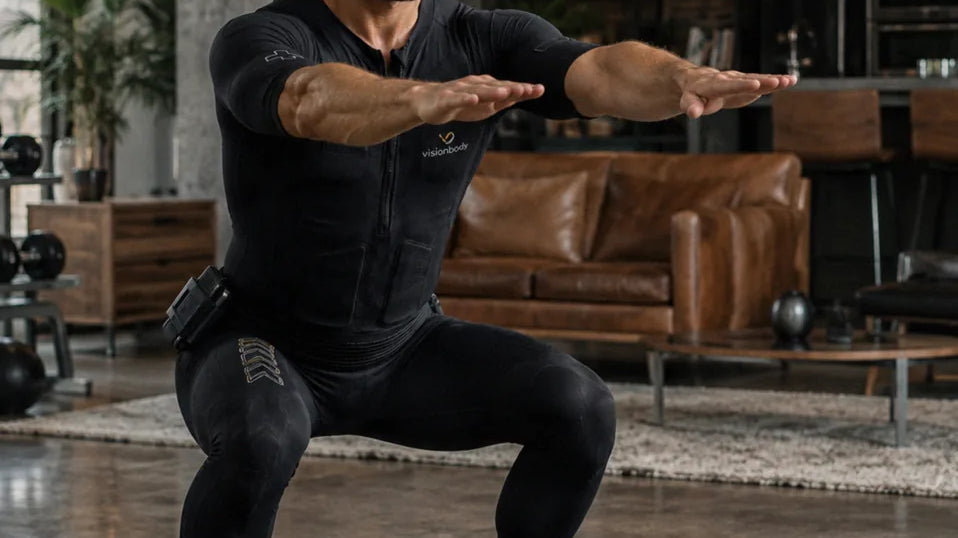
Two to three times a week, with at least 48 hours between sessions. That is the frequency Visionbody publishes for the Personal System, and it sits inside a weekly ceiling of 120 minutes of EMS training. Twice a week puts you in the range, three times is the top of it, and four is not better.
That matches what we settled on in practice: two sessions a week for the first three weeks, then three a week with a 48 to 72 hour gap. Our three month log covers how that schedule held up.
Two sessions, three at most, 48 hours apart
A Visionbody session runs 20 minutes. That is the headline figure on the product pages, and the company's own FAQ gives a slightly wider 20 to 25 minutes, so plan around 20 and treat 25 as the outer edge.
Inside those 20 minutes the structure is fixed. The app runs a mandatory warm up first, and every muscle group starts at level 0 and gets raised individually, so you build each session from nothing rather than loading a profile and hitting go. There is a published heart rate guideline of 180 minus your age. Movements stay slow and simple, mostly squats, lunges, rows and planks, because the current supplies the overload rather than heavy weight. This is not light circuit work. It is 20 minutes of stimulus reaching 24 dry electrodes across 12 channels at once, and that needs room around it.
Why the 48 hour gap is the rule that matters most
If you remember one number from this page, make it 48. Frequency is a recovery question, and recovery happens between sessions rather than during them.
The gap is also a safety margin. Excessive intensity in whole body EMS carries a documented rhabdomyolysis risk, and the standard protections against it are the three rules you have already read: start every muscle group at zero, keep sessions to 20 minutes, and leave at least two days before the next one. Those three work together, so shortening the gap takes a leg off the stool. Beginners feel this most. If soreness still means something at the 48 hour mark, hold at two sessions a week for a while before going to three.
The 120 minute weekly cap, and what sits behind it
Visionbody caps the Personal System at 120 minutes of EMS training per week. Do the arithmetic and that is six 20 minute sessions, which no sensible schedule reaches, because the 48 hour rule tops you out around three. The cap is a backstop rather than a target, and what it counts is EMS minutes. Whole body EMS is treated as a supplement to training rather than a replacement for progressive resistance work, so the cap limits the electrically driven part of your week, not the week itself.
On the regulatory side, the system is FDA cleared under 510(k) number K222386, granted to Vb Technologies AG in February 2023 in the powered muscle stimulator category. Clearance means the FDA found the device substantially equivalent to one already legally on the market. That is not FDA approval, and it is not evidence that any particular fitness result follows.
Whole body EMS also has firm contraindications: a pacemaker or any implanted electronic device, pregnancy, epilepsy, serious heart conditions, active cancer, fever, or open wounds and acute injury over the electrode areas. Users must be 18 or over. This is general information rather than medical advice, so talk to your doctor if any of it applies to you.
What a training week actually looks like
Two patterns cover almost everybody. Twice a week is Monday and Thursday. Three times is Monday, Wednesday and Friday, which lands exactly on 48 hour gaps and leaves the weekend clear.
| Sessions per week | Weekly EMS minutes (20 min each) | Shortest gap | Who it suits |
|---|---|---|---|
| 1 | 20 | Not applicable | A maintenance week, travel, or a heavy block of other training |
| 2 | 40 | 72 hours (Mon, Thu) | Beginners, returners, anyone still sore at the two day mark |
| 3 | 60 | 48 hours (Mon, Wed, Fri) | The top of the published range, once you have weeks behind you |
| 4 or more | 80 or more | Under 48 hours on at least one gap | Nobody. It breaks the recovery rule before it reaches the cap |
Even the three session week uses only 60 of your 120 available minutes, and that headroom is not an invitation. The app ships with 8 advanced programs and 64 subprograms, so add variety inside the 20 minutes rather than adding a fourth day. The Personal System and its program library are listed in full on the product page. The other thing new owners get wrong is front loading: four sessions in week one, then nothing for ten days.
What the research says about EMS frequency
The published work lines up with the manufacturer guidance, which is not always the case in fitness equipment. Kemmler and von Stengel are the main researchers in whole body EMS, and studies here typically use 20 minute sessions one to two times per week.
So train twice a week and you are training at the frequency the evidence base actually studied. The evidence is also strongest in beginners and returners, which is a useful match, because those are the people for whom 20 minutes twice a week is realistic and an hour three times a week is not. The consistent finding is that EMS supplements training rather than replacing progressive resistance work.
Your training frequency sets your washing schedule
People work this out too late. Visionbody says to wash the suit after every two to three sessions, because salt buildup weakens conductivity. Train three times a week and you are running roughly a wash a week, which matters because one warranty tier is measured in washes. The three tiers run from the ship date:
- PowerBox: 3 year limited warranty.
- PowerSuit functional components (electrodes, wiring, connection plate): 6 months, up to a maximum of 100 wash cycles.
- PowerSuit textile: 30 days.
Read the middle line carefully. "100 washes" is a warranty limit, not a durability rating. Registration and proof of purchase are required, and claims go in within 10 calendar days of return.
One instruction catches people out: do not turn the suit inside out to wash it. Inside out is a post workout air drying step only, and the two get conflated constantly. Machine wash cold on a gentle cycle at 800 rpm spin, in the provided laundry bag, all Velcro fastened, mild bleach free detergent. The control box stays out, and the suit dries flat away from high heat. Prohibited: hand washing, dry cleaning, drying in direct sunlight, sports detergents, fabric softener, bleach, tumble drying, ironing and wringing it out.
Training more often does not cost you more
With some EMS suits, frequency and cost are linked. Katalyst sells at $2,999 plus a mandatory $35 to $49 per month subscription, has 26 electrodes, and is iOS only. A monthly charge and a training schedule move independently.
Visionbody sells the system outright. There is no subscription and no membership, and the My Visionbody App for iOS and Android comes with the system, listed in the package contents. Nothing recurs after you buy, so how often you train stays a training question.
| Configuration | US (visionbody.com) | EU (visionbody.eu) | DACH (visionbodyshop.com) |
|---|---|---|---|
| Single (1 suit, 1 PowerBox) | $1,890 (was $2,490) | €1.790 (was €2.490) | €1.790 (was €2.490) |
| Duo (2 suits, 1 PowerBox) | $2,390 (was $3,290) | €2.290 | €2.390 |
| Double (2 suits, 2 PowerBoxes) | $3,490 (was $4,990) | €3.490 (was €4.990) | €3.490 (was €4.990) |
| Recurring fees | No subscription, no membership | ||
Our code ROUTINES50 takes $56.70 off. If it will not apply, Visionbody runs seasonal pricing automatically and carts usually accept one code at a time, so an automatic promo already on the cart can block a second one.
On the US store only there is a deposit plan with no credit check: $890 today and $1,000 on delivery, $1,890 in total, with the balance charged to the same card when the order ships. That is a payment schedule, not credit. No installment financing exists on the EU or DACH stores, so European and UK buyers pay in full, and UK visitors are routed to the EU store and billed in euros because no UK storefront or GBP pricing exists. Batteries also cannot ship to the UK, Arabian countries, Africa, Asia or Russia, so buyers there source the LP-E10 compatible battery locally. See pricing for your market → before you commit.
Start at twice a week and earn the third
Sixty minutes of EMS a week is the whole commitment, with no gym drive and no special clothing beyond a thin seamless layer. Give yourself three or four weeks at two sessions, see how the 48 hour mark feels, then add the third day if recovery is comfortable. The Visionbody Personal System takes 2 to 3 business days to process and 3 to 5 working days to deliver in the US, with a 21 day return window from delivery.
More from our EMS hub
Frequently asked questions
How often should you do EMS training?
Two to three sessions a week, at least 48 hours apart. The Personal System is capped at 120 minutes of EMS training per week, and a session is 20 minutes, so three sessions uses 60 of those minutes.
Can I do EMS two days in a row?
No. The published guidance is at least 48 hours between sessions. Back to back days remove the recovery window, and excessive intensity in whole body EMS carries a documented rhabdomyolysis risk.
How long is one EMS session?
20 minutes is the headline figure on Visionbody's product pages, and its own FAQ gives 20 to 25 minutes. A mandatory in-app warm up runs first, and every muscle group starts at level 0.
Is twice a week enough?
For most people, yes, especially beginners and returners. Whole body EMS studies typically use 20 minute sessions one to two times a week, so twice a week matches what the research tested.
Can I train normally on the days in between?
The 48 hour gap and the 120 minute cap apply to EMS sessions. EMS is positioned as a supplement to training rather than a replacement for progressive resistance work. General information, not medical advice.
How often do I wash the suit if I train three times a week?
Wash after every two to three sessions, so three sessions a week means roughly a wash a week. Keep count: the functional components warranty covers 6 months up to a maximum of 100 wash cycles.
Does training more often cost more?
No. Visionbody sells the system outright, with no subscription and no membership, and the app comes with it. The single is $1,890 in the US and €1.790 in the EU and DACH markets. ROUTINES50 takes $56.70 off.
Who should not do EMS training?
Anyone with a pacemaker or implanted electronic device, and anyone pregnant or living with epilepsy, serious heart conditions, active cancer, fever, or open wounds over the electrode areas. Users must be 18 or over.