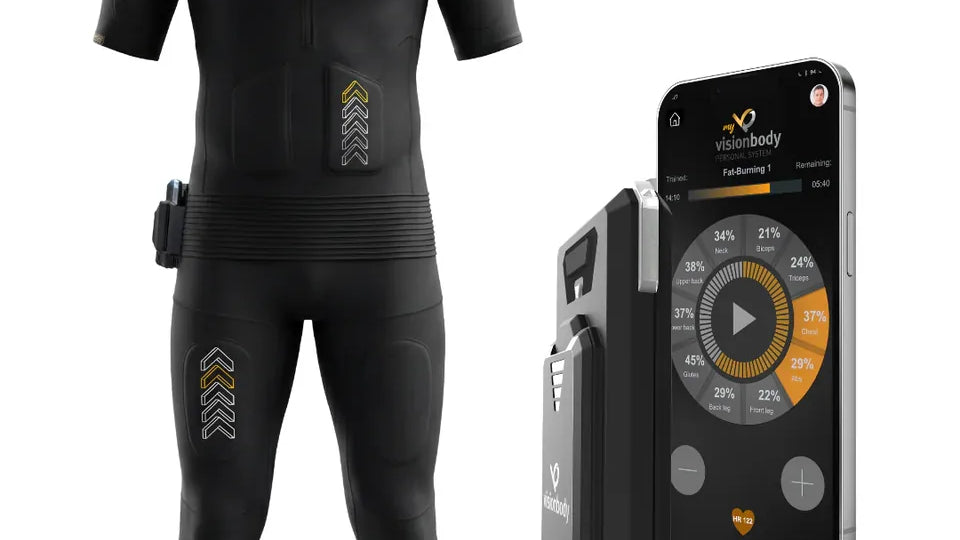
Most of what gets called an EMS side effect is just the effect of hard training. Muscle soreness the next day, a few hours of real fatigue, and a heavy feeling in whichever areas worked hardest are all ordinary. The one that genuinely matters is rhabdomyolysis, a documented risk of excessive intensity, and it is exactly why a properly built whole body EMS protocol starts every muscle group at zero, holds the session to 20 minutes, and leaves at least 48 hours before the next one.
This page is general information, not medical advice. If you have a health condition, take medication, or are unsure whether electrical muscle stimulation suits you, speak to a doctor before your first session.
What a normal response to EMS looks like
A whole body suit is not a single pad stuck on a sore shoulder. The Visionbody PowerSuit puts 24 dry electrodes across 12 independently controlled channels, so a 20 minute session works legs, glutes, back, abs, chest and arms inside the same short block. That much muscle stimulated at once produces what any hard session produces: soreness.
What catches beginners out is where the soreness comes from. During an EMS session the movements stay slow and simple. Squats, lunges, rows, planks. The current supplies the overload, not heavy weight. So you finish without the usual signals of a punishing gym session, no grinding last rep, no loaded bar, and then the next morning your glutes tell you precisely how much work happened. That gap between how the session felt and how the next day feels is the usual reason people assume something went wrong. Usually nothing did.
Fatigue in the hours afterwards belongs in the same category. Twenty minutes of repeated contraction across most of your body is a genuine training load, so treat the rest of the day the way you would after any hard workout. Eat, hydrate, sleep.
Rhabdomyolysis is the risk worth naming
Rhabdomyolysis is the clinical term for muscle tissue breaking down on a scale that releases its contents into the bloodstream and puts a load on the kidneys. In whole body EMS, excessive intensity carries a documented risk of it. That one sentence is why the rules in this article exist rather than being decoration, and the literature is public if you want to read it yourself on PubMed.
Avoiding it is not complicated. Excessive intensity is the driver, so the protective factors are the ones that keep intensity, duration and frequency in check: start low, stay short, and let the muscle recover before you go again. Zero, 20 and 48 are not arbitrary numbers.
Why every muscle group starts at zero
The app makes you warm up first. It is mandatory, and it is not there to pad the session. Then every muscle group starts at level 0 and gets raised individually.
That second part is the piece of engineering doing the real work. With 12 channels you are not turning up one master dial that drives your quads and your abs at the same setting. You raise each region on its own, from nothing, until it reaches a level you can hold with good form. Your abs may want a fraction of what your glutes want. Your lower back may want less again. A single global intensity would have to overshoot somewhere to be useful anywhere, and overshoot is the input that carries the risk. Per muscle control is built into the 12 channel PowerSuit and PowerBox, not bolted on as a setting you have to remember to use.
In practice, on your first session, raise each group only until you feel a clear, controlled pull, then leave it there. There is no prize for a higher number. The app carries 8 advanced programs and 64 subprograms, and in every one of them the starting point is the same: zero, raised group by group.
Why 20 minutes, 48 hours apart, and a weekly ceiling
Twenty minutes is the headline session length on Visionbody's product and marketing pages, and their FAQ gives a range of 20 to 25 minutes. Either way the session is short by design, and the shortness is the point. You train 2 to 3 times per week with at least 48 hours between sessions, and the Visionbody Personal System is capped at 120 minutes of EMS training per week.
A weekly ceiling written into the system is worth pausing on. Most fitness equipment lets you do as much as you like and calls that a feature. The cap exists because the 48 hour rule only means something if the week as a whole respects it.
The research lands in the same place. Studies of whole body EMS, including the body of work from Kemmler and von Stengel, typically use 20 minute sessions once or twice a week, and the evidence is strongest in beginners and returners. The protocol on your phone is not a watered down version of what researchers run, and EMS is a supplement to training rather than a replacement for progressive resistance work.
One more number to keep in mind during a session: the heart rate guideline is 180 minus your age. If you are 40, that is 140. Sailing past it is a signal to bring intensity down, not a badge.
Normal or not: a quick reference
| What you notice | Most likely reading | What to do |
|---|---|---|
| Muscle soreness the next day, like a hard gym session | New stimulus spread across a lot of muscle at once | Keep the 48 hour gap, hydrate, and come back a little lower if it lingers |
| Deep tiredness for a few hours afterwards | Twenty minutes of contraction is a real training load | Eat and sleep. Treat it like any hard workout |
| A strong pulling or tingling sensation as a channel ramps up | The current doing its job at the level you set | You control each channel individually. Back it off if it is more than you can hold with good form |
| One spot feeling sharp while everything else feels fine | Usually a contact issue at that pad rather than an intensity issue | Stop, check the fit and the seamless layer underneath, and wash the suit if it is due |
| Heart rate climbing well past 180 minus your age | Working harder than the guideline intends | Reduce intensity and slow the movement down |
| Soreness worsening rather than easing after 48 hours, dark or cola coloured urine, severe swelling, weakness out of proportion to the session | The signs clinicians associate with rhabdomyolysis | Stop training and seek medical attention the same day |
| Chest pain, palpitations, faintness or breathlessness | Not an expected training response | Stop and seek medical attention |
Who should not train with whole body EMS
Whole body EMS carries a standard contraindication list, and it is not a soft one. Do not train in a suit if any of the following applies to you:
- A pacemaker or any implanted electronic device
- Pregnancy
- Epilepsy
- Serious heart conditions
- Active cancer
- Fever
- Open wounds or acute injury over the electrode areas
The system is for adults, 18 and over. If your situation is not on that list but sits close to it, a recent surgery, a chronic condition, a medication that affects muscle or kidney function, that is a conversation with your doctor rather than a judgement call to make at home. Again, none of this is medical advice.
Skin contact, fit and washing
A fair amount of what gets reported as an unpleasant sensation turns out to be a contact problem rather than an intensity problem. The electrodes are dry, so there is no gel to apply and no wetting step. What they do need is a clean surface and even pressure.
Wear a thin seamless layer underneath. No padding, no underwire, nothing that lifts an electrode away from skin. Past that, no special clothing is required.
Washing matters more than people expect, because salt from sweat builds up in the fabric and weakens conductivity. Wash after every 2 to 3 sessions. Machine wash cold on a gentle cycle at 800 rpm, inside the laundry bag that comes in the box, with all Velcro fastened, using a mild bleach free detergent (a gentle baby detergent works best). Never wash the control box with the suit.
Two details are easy to get backwards. First, do not turn the suit inside out to wash it. Inside out is a post workout air drying step, and that is all it is. Second, this list is prohibited outright: hand washing, dry cleaning, drying in direct sunlight, sports detergents, fabric softener, bleach, tumble drying, ironing, wringing out. Dry flat, away from open flame or high heat.
Read the warranty before you assume the cover is longer than it is. The PowerSuit's functional components (electrodes, wiring, connection plate) carry a 6 month or 100 wash cycle warranty, whichever comes first, the textile carries 30 days, and the PowerBox carries 3 years. That 100 wash figure is a warranty limit rather than a durability rating, and washing every 2 to 3 sessions as advised puts it within reach during normal use.
What FDA clearance does and does not tell you
Visionbody is FDA cleared under 510(k) number K222386. The applicant is Vb Technologies AG, the decision is recorded as "Substantially Equivalent" and dated 24 February 2023, and the device sits in Class II under product code NGX and 21 CFR 890.5850, classified as "Stimulator, Muscle, Powered, For Muscle Conditioning". Clearance means the FDA agreed the device is substantially equivalent to one already legally marketed. It is not FDA approval, and it is not evidence that any particular fitness result will follow.
That distinction matters, because plenty of this category gets it wrong, some of Visionbody's own pages included. The number is real and checkable in the FDA's public 510(k) database, so you do not have to take anyone's word for it. The system is designed and manufactured in Germany.
On price, since it tends to come up alongside safety: in the US the single system (one suit, one PowerBox) is $1,890, down from a $2,490 list price, and our code ROUTINES50 takes $56.70 off. In the EU and DACH markets the single is €1.790. There is no subscription and no membership, and the My Visionbody app for iOS and Android comes with the system. The protocol was built around the risk rather than around ignoring it. Start at zero, stop at 20 minutes, wait 48 hours, and read the contraindication list before you order. See the current configurations and pricing here.
More from our EMS hub
Frequently asked questions
Is muscle soreness after EMS training normal?
Yes. A 20 minute session with 24 dry electrodes across 12 channels works legs, glutes, back, abs, chest and arms at once, so next day soreness is an ordinary response to that much stimulus. What throws people is the mismatch: the movements are slow and simple, squats, lunges, rows, planks, and the current supplies the overload rather than heavy weight, so the session itself does not feel like a punishing gym workout. Keep the 48 hour gap, hydrate, and dial the intensity down slightly next time if the soreness lingers. This is general information, not medical advice.
What is rhabdomyolysis, and how do I avoid it?
Rhabdomyolysis is the clinical term for muscle tissue breaking down on a scale that releases its contents into the bloodstream and loads the kidneys. In whole body EMS, excessive intensity carries a documented risk of it. Avoiding it comes down to controlling intensity, duration and frequency: start every muscle group at level 0, keep sessions to 20 minutes, train 2 to 3 times a week with at least 48 hours between sessions, and stay inside the 120 minute weekly cap. If soreness worsens rather than eases after 48 hours, or you notice dark urine, severe swelling or weakness out of proportion to the session, stop training and seek medical attention the same day.
Can I use an EMS suit with a pacemaker?
No. A pacemaker or any implanted electronic device is on the standard contraindication list for whole body EMS, along with pregnancy, epilepsy, serious heart conditions, active cancer, fever, and open wounds or acute injury over the electrode areas. The system is for adults 18 and over. If your situation sits near that list rather than on it, a recent surgery or a medication affecting muscle or kidney function for example, that is a question for your doctor. None of this is medical advice.
How long should I wait between EMS sessions?
At least 48 hours. The recommended pattern is 2 to 3 sessions per week, and the Personal System is capped at 120 minutes of EMS training per week. The gap is not padding: recovery is the part of the week that turns the stimulus into adaptation, and compressing it is exactly the behaviour the intensity rules exist to prevent. Research on whole body EMS, including work from Kemmler and von Stengel, typically uses 20 minute sessions once or twice a week.
Why does the app make me start every muscle group at zero?
Because a single global intensity would have to overshoot somewhere to be useful anywhere, and overshoot is the input that carries the risk. With 12 independently controlled channels you raise each region on its own, from 0, until it reaches a level you can hold with good form. Your abs will usually want far less than your glutes. The in app warm up is mandatory before any of that starts, and there is no prize for a higher number on session one.
Should any part of an EMS session feel sharp or stinging?
No. A strong pulling or tingling sensation as a channel ramps up is the current doing its job at the level you set. One spot feeling sharp while everything else feels fine usually points to contact rather than intensity. Stop, check the fit, check the thin seamless layer underneath (no padding, no underwire), and wash the suit if it is due. Salt from sweat builds up in the fabric and weakens conductivity, which is why the guidance is to wash after every 2 to 3 sessions.
Is Visionbody FDA cleared?
Yes. Visionbody holds 510(k) number K222386, applicant Vb Technologies AG, with the decision recorded as "Substantially Equivalent" and dated 24 February 2023. It sits in Class II under product code NGX and 21 CFR 890.5850, classified as "Stimulator, Muscle, Powered, For Muscle Conditioning". Clearance means the FDA agreed the device is substantially equivalent to one already legally marketed. It is FDA clearance, not FDA approval, and clearance is not evidence that any particular fitness result will follow.
What if I try it and cannot tolerate it?
The return window is 21 days from delivery. Contact support inside that window to get a Return Authorization number before sending anything back. The buyer pays return shipping unless the fault is Visionbody's, and refunds are issued within 14 business days of inspection. On warranty, the PowerBox carries 3 years, the PowerSuit's functional components (electrodes, wiring, connection plate) carry 6 months or 100 wash cycles, whichever comes first, and the textile carries 30 days.