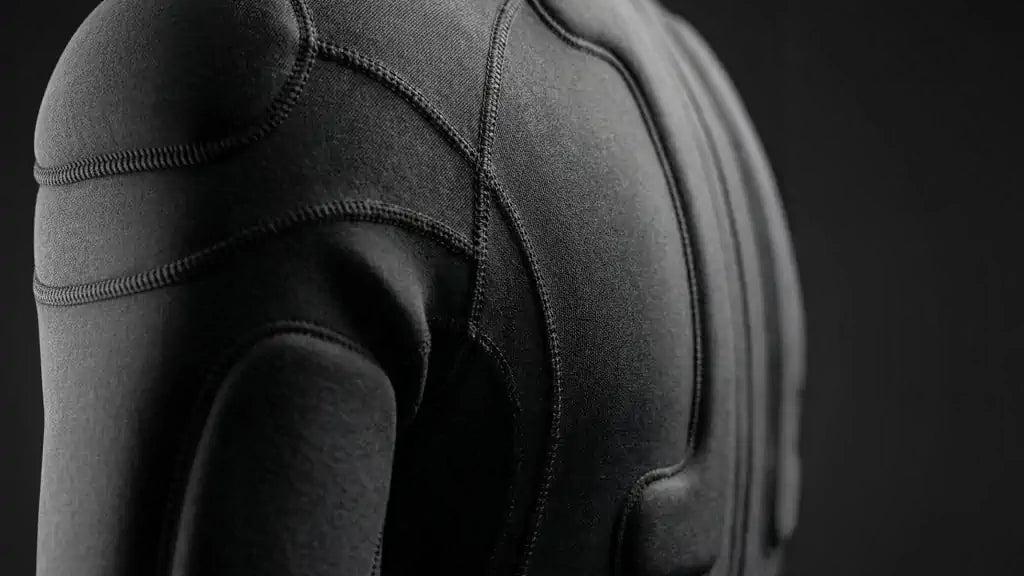
The Visionbody PowerSuit carries 24 dry electrodes running on 12 channels, and the app lets you set intensity for each muscle group on its own. There's no gel, no conductive spray, and no measuring pad positions against a diagram. You zip up, pair the PowerBox, and every electrode is already sitting on the muscle it was built for.
That's the practical difference between a suit and a strip of stick-on pads. Placement stops being a skill you relearn every session and becomes a property of the garment. What's left for you to get right is fit, and that part is worth understanding before you order.
24 dry electrodes on 12 channels
Start with the hardware count, since it's the number most buyers compare first. The PowerSuit carries 24 electrodes. They're dry, so nothing needs wetting, gelling or peeling off afterwards. Those 24 pads run on 12 channels, and 12 is the number that matters once you're training: you steer intensity by muscle group, not pad by pad.
Driving all of it is the PowerBox, a wireless controller that sits in a holster on the waist belt and talks to your phone over Bluetooth. It runs on an LP-E10 rechargeable battery, about 6 hours per charge, and charges over USB-C. The charger is voltage agnostic worldwide, so travelling means packing a plug adapter and nothing else. Pairing is one button: hold the front button for about 3 seconds. Pulsing blue means it hasn't connected, solid blue means it has.
The box holds the PowerSuit, the PowerBox, the LP-E10 battery, a USB-C cable, a laundry net and the manual. The My Visionbody App comes with the system, for iOS and Android. The suit itself is designed and manufactured in Germany.
What 12 channels feels like in a session
Every muscle group starts at level 0, and you raise each one individually during a warm up the app makes mandatory before any working set. That's the whole point of channel separation. Your glutes and your biceps don't want the same current, and on a suit you're not forced to give them the same current.
The app carries 8 advanced programs and 64 subprograms, and works back to iOS 12.4. A published Visionbody app screen shows the per muscle dials mid session, with separate percentages for glutes, upper back, chest, lower back, neck, abs, back leg, triceps, front leg and biceps. Ten named groups, ten independent numbers, one session. EMS work needs a connected PowerBox; without one the app still gives you the instructional videos and setup guides.
Sessions run 20 minutes (Visionbody's FAQ quotes 20 to 25), 2 to 3 times a week, with at least 48 hours between them. The Personal System is capped at 120 minutes of EMS training per week. The heart rate guideline is 180 minus your age.
Per-channel levels settle differently for everyone. Our three month log lists the intensity we ended up on for each muscle group after thirty-odd sessions.
Where the pads sit, front and back
Coverage follows the same map as the dials. On the front you get chest, abdominals, biceps and the front of the legs, with the zip running down between the chest pads. Around the shoulders and upper arms the pads are contoured to follow the muscle rather than lying flat across it. On the back you get upper back, lower back, glutes, the back of the legs and triceps, plus the neck and upper trap area.
That's torso and limbs firing together, which is why a whole body session compresses so much work into 20 minutes. It's also why the movements stay slow and simple: squats, lunges, rows, planks. The current supplies the overload, so you don't need heavy weight stacked on top of it. You can see the full suit and PowerBox setup here.
Suit versus stick-on pads
Conventional EMS pads ask you to do three jobs the suit does for you.
Placement. With pads you're hunting a motor point, checking a diagram, and repeating that from scratch every time. Small differences in where a pad lands change what you feel. A suit fixes the geometry in the garment, so session 40 is set up exactly like session 1.
Conductivity. Pad systems generally want gel or a wetted surface. Visionbody's electrodes are dry. Nothing to buy, nothing to spread, nothing to forget on a work trip.
Coverage. A typical pad unit drives a handful of outputs into one or two areas. Twelve channels across a full suit reach ten labelled muscle groups inside a single 20 minute block.
What you give up is positional granularity. You can't slide a pad two centimetres to the left. In return you get repeatability, which for someone training at home twice a week matters far more than millimetre placement.
Fit is the other half of placement
An electrode only works where it touches. Held even slightly off the skin it does nothing useful, so fit is a performance question rather than a comfort one.
Underneath the suit you wear a thin seamless layer and nothing else. No padding, no underwire. Anything with structure sits between an electrode and the muscle beneath it, and that gap is the enemy. Otherwise there's no special kit to buy, which is one of the quieter conveniences of training in a suit at home.
There's no published size chart. Instead, Visionbody emails you for measurements after you order. That adds a step to delivery, and it means the suit arrives matched to your measurements rather than to a letter on a grid. The system is 18+ only, US support runs through support-usa@visionbody.com, and if the fit still isn't right, the return window is 21 days from delivery. Contact support inside that window for a Return Authorization number.
How the coverage compares
| System | Electrode figures we hold | Price |
|---|---|---|
| Visionbody | 24 dry electrodes, 12 channels, no gel | $1,890 US single (was $2,490) |
| Katalyst | 26 electrodes, iOS only | $2,999 plus a mandatory $35 to $49 per month subscription |
| TitanBody | 20 dry electrode zones, 10 channels | $1,895 solo against a $2,495 regular price |
| SQAI | Wet system | $2,795 |
| ANTELOPE | 18 electrodes | Around 999 euros on sale |
We list only the figures we hold verified for each brand. Where a column has nothing to say about a rival, that's a gap in our records rather than a statement about what the brand does or doesn't disclose, so we leave it out instead of guessing.
Electrode count on its own is a weak proxy for anything. Katalyst has 26 electrodes and runs iOS only, at $2,999 plus a mandatory $35 to $49 per month subscription. Visionbody's own comparison table lists paid membership and hidden fees as not applicable, so nothing recurs after you buy the system. TitanBody has 20 dry electrode zones on 10 channels, launched in September 2025, and has roughly 15 Trustpilot reviews so far, so no long term owner feedback exists yet. SQAI is $2,795 and a wet system. ANTELOPE is around 999 euros on sale with 18 electrodes and an EU focus. Studio grade rigs from Wiemspro and XBody run $8,500 to $20,000 and above. Factory suits from SBODY and BruteSuits sit between $399 and $830 with no published FDA clearance.
Care that protects conductivity
Dry electrodes conduct through the pad surface, and sweat leaves salt on that surface. Salt buildup weakens conductivity, so wash the suit after every 2 to 3 sessions.
Do not turn the suit inside out to wash it. Visionbody says so explicitly, and it's the most commonly garbled instruction in home EMS. Inside out is an air drying step after a workout, not a washing step.
Machine wash cold on a gentle cycle at 800 rpm spin, inside the provided laundry bag, with all Velcro fastened, using a mild bleach free detergent (a gentle baby detergent works best). Never wash the control box with the suit. Dry flat, away from open flame or high heat.
Prohibited outright: hand washing, dry cleaning, drying in direct sunlight, sports detergents, fabric softener, bleach, tumble drying, ironing and wringing out.
Warranty comes in three tiers and it's worth reading before you build a routine around it. The PowerBox carries a 3 year limited warranty. The PowerSuit's functional components, meaning electrodes, wiring and the connection plate, are covered for 6 months or a maximum of 100 wash cycles. The textile is covered for 30 days. Read 100 washes as a warranty limit rather than a durability rating: wash every 2 to 3 sessions as advised and you'll approach that count while the suit is still perfectly serviceable. Cover runs from ship date and needs registration plus proof of purchase.
Safety, clearance and what it costs
Visionbody is FDA cleared under 510(k) number K222386, decided 2023-02-24 for applicant Vb Technologies AG. Clearance means the FDA found the device substantially equivalent to a legally marketed device. That is not FDA approval, and it isn't proof of any particular fitness result. Several EMS brands blur that line, Visionbody included on parts of its own site. Cleared is the correct word.
Whole body EMS carries the standard contraindications. Skip it if you have a pacemaker or any implanted electronic device, if you're pregnant or epileptic, if you have a serious heart condition, active cancer, a fever, or open wounds and acute injury over the electrode areas. 18+ only. Excessive intensity carries a documented rhabdomyolysis risk, which is precisely why the protocol starts every group at level 0, holds sessions at 20 minutes, caps the Personal System at 120 minutes a week and leaves 48 hours in between. Treat all of this as general information rather than medical advice.
In the US the single system (one suit, one PowerBox) is $1,890, down from a $2,490 list price. The duo (two suits, one box) is $2,390 and the double (two suits, two boxes) is $3,490. In Europe the single is EUR 1.790 and the double EUR 3.490, with the duo at EUR 2.290 on visionbody.eu and EUR 2.390 on the DACH store. US buyers also have a deposit plan with no credit check: $890 today, then $1,000 charged to the same card on delivery, for $1,890 in total. That plan is US only.
Our code ROUTINES50 takes $56.70 off. If it doesn't apply at checkout, check whether a seasonal promotion is already sitting on the cart, since Visionbody applies some pricing automatically and carts usually accept one code at a time. See pricing and configurations →.
More from our EMS hub
Frequently asked questions
How many electrodes does the Visionbody suit have, and do they need gel?
The PowerSuit carries 24 electrodes running on 12 channels. They are dry electrodes, so there is no gel, no conductive spray and no wetting step before a session. You set intensity by muscle group rather than pad by pad.
Where are the electrodes positioned on the body?
Coverage runs across the torso and limbs. On the front that means chest, abdominals, biceps and the front of the legs, with the zip running between the chest pads. On the back it means upper back, lower back, glutes, the back of the legs and triceps, plus the neck and upper trap area. A published Visionbody app screen shows separate dials for glutes, upper back, chest, lower back, neck, abs, back leg, triceps, front leg and biceps.
How is an EMS suit different from stick-on EMS pads?
The suit fixes electrode geometry in the garment, so every session starts from the same placement instead of you finding motor points against a diagram. The electrodes are dry, so there is no gel to buy or apply. And 12 channels reach ten labelled muscle groups inside one 20 minute block, where a pad unit typically drives a few outputs into one or two areas. The trade-off is that you cannot reposition an individual pad.
What do I wear under the EMS suit?
A thin seamless layer and nothing else. No padding and no underwire. Anything with structure sits between an electrode and the muscle underneath, and an electrode only works where it makes contact.
Is there a size chart, and how do I get the right fit?
Visionbody publishes no size chart. They email you for measurements after you order, so the suit is matched to your measurements rather than to a letter on a grid. The system is 18+ only. If the fit is still wrong, the return window is 21 days from delivery: contact support inside that window for a Return Authorization number.
Can I set the intensity for individual muscles?
Yes. Every muscle group starts at level 0 and is raised individually during a warm up the app makes mandatory before any working set. Sessions run 20 minutes (the Visionbody FAQ quotes 20 to 25), 2 to 3 times a week with at least 48 hours between them, and the Personal System is capped at 120 minutes of EMS training per week. The heart rate guideline is 180 minus your age.
How does the electrode count compare to Katalyst?
Katalyst has 26 electrodes and runs iOS only, at $2,999 plus a mandatory $35 to $49 per month subscription. Visionbody has 24 electrodes on 12 channels, and its own comparison table lists paid membership and hidden fees as not applicable, so nothing recurs after you buy the system. Both brands hold FDA clearance, which means the FDA found each device substantially equivalent to a legally marketed device. Raw electrode count on its own tells you very little.
How do I keep the electrodes conducting well, and can I replace the battery?
Sweat leaves salt on the pad surface and salt buildup weakens conductivity, so wash the suit after every 2 to 3 sessions: cold, gentle cycle, 800 rpm spin, inside the provided laundry bag with all Velcro fastened, using a mild bleach free detergent. Do not turn the suit inside out to wash it; inside out is an air drying step after a workout. Dry flat, away from open flame or high heat. The battery is user-replaceable and Canon LP-E10 compatible (7.4V, 900 to 1100 mAh). Visionbody does not sell batteries, and batteries cannot ship to the UK, Arabian countries, Africa, Asia or Russia, so buyers there source one locally.