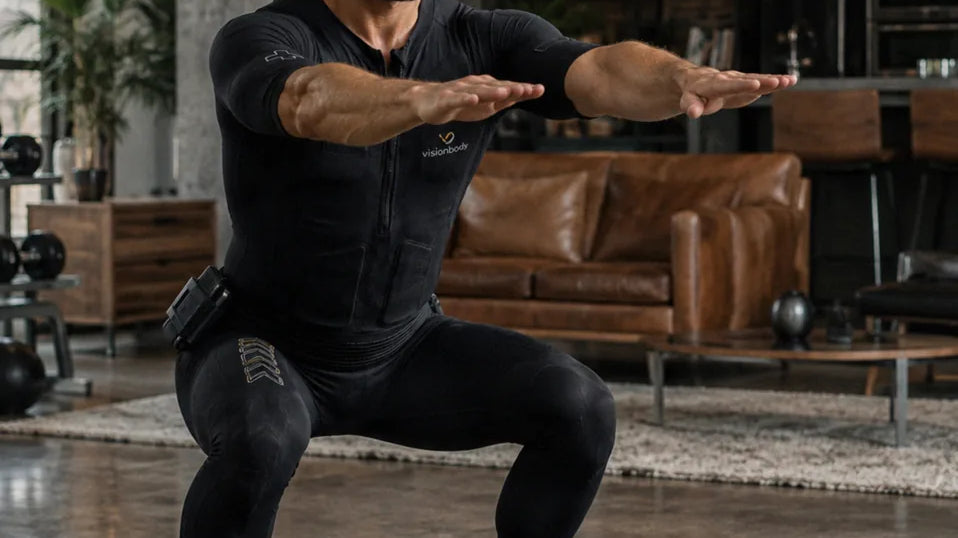
A 20 minute EMS workout is one continuous session: a mandatory warm up run by the app, then about ten minutes of slow, simple movement while a low frequency current fires your muscles through 24 dry electrodes, then a taper back to zero. Twenty minutes is the whole workout, and it is the protocol rather than a round marketing number: it is the dose the research uses and the dose the safety guidance supports.
Twenty minutes sounds easy written down. It is not, and our three month log explains why you finish one drenched.
Here is what happens in each block, and how the 20 minutes fit into a week.
The session, minute by minute
This is the shape of a full session on the Visionbody Personal System. The app runs the mandatory warm up and the program clock. The timings below are a practical template, not a specification printed by the app.
| Clock | Block | What you do |
|---|---|---|
| Before the clock | Kit and pairing | Suit on over one thin seamless layer. Hold the PowerBox button about 3 seconds: pulsing blue is not connected, solid blue is connected |
| 0:00 to 3:00 | Mandatory warm up | Easy movement. Nothing is turned up yet |
| 3:00 to 6:00 | Ramp from zero | Bodyweight squats or marching while you raise each muscle group from level 0, one at a time |
| 6:00 to 16:00 | Working blocks | Squats, lunges, rows, planks. Slow and controlled. The current supplies the overload, not weight |
| 16:00 to 20:00 | Taper | Intensity comes down group by group. Check your heart rate against 180 minus your age |
| After | Suit care | Turn the suit inside out to air dry. Wash it in the laundry net every 2 to 3 sessions |
Minutes 0 to 3: the warm up you do not skip
The warm up is mandatory and built into the app, so there is no version of this session where you strap in and go straight to a working level. That is a design decision, not an inconvenience.
Get the kit right beforehand and the warm up costs nothing. You want one thin seamless layer under the suit, no padding, no underwire, no thick seams, because anything bulky lifts an electrode off your skin and that group fires unevenly all session. The battery runs about 6 hours per charge over USB-C, so charging is not a per session chore.
Minutes 3 to 6: everything starts at zero
This is the block people underestimate. There are 24 dry electrodes across 12 channels, and every muscle group starts at level 0 and is raised individually. You are not turning up a master dial. You are setting glutes, abs, back, chest, arms and legs one at a time, each to a level you can hold.
Dry electrodes remove a step: no gel, no spray bottle, no soaking the suit. If a group feels weak, more intensity is almost never the answer. Check the suit is snug, the base layer smooth, and whether that channel is still near zero. See how the per muscle control works if you want the hardware detail.
Minutes 6 to 16: the ten minutes that do the work
The movements stay deliberately simple: squats, lunges, rows, planks. The current supplies the overload, so a bodyweight squat under stimulation asks far more of your legs than the same squat in a normal set.
Pace is the skill. Move slowly, hold through the impulse, release as it drops, and keep breathing instead of bracing. The My Visionbody app carries 8 advanced programs and 64 subprograms, runs on iOS and Android, and comes with the system. A session needs a connected PowerBox, so keep the phone in Bluetooth range for the full 20 minutes. Use 180 minus your age as your heart rate guideline: at 40, that is 140.
Minutes 16 to 20: taper, then the housekeeping
The last few minutes bring intensity down rather than stopping dead. After that, all that is left is care.
Turn the suit inside out and hang it to air dry. That is a drying step only. Do not turn it inside out to wash it, because Visionbody says so explicitly. Washing happens every 2 to 3 sessions: all Velcro fastened, suit inside the supplied laundry net, cold gentle cycle at 800 rpm, mild bleach free detergent, control box never in the machine with it. Dry flat, out of sunlight, away from heat. No hand washing, dry cleaning, sports detergents, fabric softener, bleach, tumble drying, ironing or wringing.
Worth knowing early: the warranty covers the suit's functional components for 6 months or 100 wash cycles, whichever lands first, the PowerBox for 3 years and the textile for 30 days. That is a warranty limit, not a durability rating.
Why 20 minutes is the protocol
Twenty minutes is not a compressed version of a longer workout. It is the length the whole body EMS literature uses. Kemmler and von Stengel, the main researchers in the field, typically run 20 minute sessions once or twice a week, and the strongest results show up in beginners and returners. Visionbody's product pages say 20 minutes and its FAQ gives a 20 to 25 minute range, so running slightly long is still inside their guidance.
The ceiling exists for a reason. Excessive intensity carries a documented risk of rhabdomyolysis, and that risk is why the protocol starts every group at zero, holds the session at 20 minutes and leaves at least 48 hours between sessions. The Personal System is capped at 120 minutes of EMS training per week. Treating 20 minutes as a floor to build on is the one mistake worth avoiding.
Two or three sessions a week, and who should sit this out
The pattern is 2 to 3 sessions a week with at least 48 hours between them: Monday and Thursday, say, or Monday, Wednesday and Saturday. The 48 hours is a stated requirement, not a suggestion, and the weekly ceiling of 120 minutes sits on top of it.
Whole body EMS is for adults, 18 and over. Skip it if you have a pacemaker or any implanted electronic device, if you are pregnant, or if you have epilepsy, a serious heart condition, active cancer, a fever, or open wounds and acute injury over the electrode areas. Ask your doctor first if you have any medical condition. This is general information, not medical advice.
The system is FDA cleared under 510(k) number K222386, granted February 2023 to VB Technologies AG as a Class II powered muscle stimulator. Clearance means the FDA found it substantially equivalent to a stimulator already legally on the market. It is not FDA approval, and not proof of any particular result.
What owning the 20 minutes costs
A home suit is a one off purchase, not a running cost. In the US the Visionbody single system, one suit and one PowerBox, is $1,890 against a $2,490 list price. The duo, two suits sharing one box, is $2,390, and the double, two suits and two boxes, is $3,490. In Europe the single is EUR 1.790, the duo EUR 2.290 on the EU store and EUR 2.390 on the DACH store, and the double EUR 3.490. Our code ROUTINES50 takes $56.70 off. Visionbody applies seasonal pricing automatically and the cart usually takes one code at a time, so clear any promo on the cart if ROUTINES50 will not apply.
There is no subscription and no membership. Nothing recurs after you buy, and the app comes with the system.
| Visionbody | Katalyst | |
|---|---|---|
| Price | $1,890 in the US, list $2,490. EUR 1.790 in Europe | $2,999 |
| Recurring cost | No subscription, no membership | Mandatory $35 to $49 per month |
| Electrodes | 24 dry, across 12 channels | 26 |
| Phone platform | iOS and Android | iOS only |
A spare Ultimate Suit 5.0, the 12 channel version, is $489, and a support belt is $39. Returns run 21 days from delivery. See pricing for your market →, because the US, EU and DACH stores are genuinely separate.
In the US only, there is a deposit plan with no credit check: $890 today, $1,000 when the order ships, $1,890 total. That is a payment schedule against a card on file, not credit, and it is not offered in Europe. Start with the single system if you are the only person training, since the duo shares one PowerBox and one session slot.
More from our EMS hub
Frequently asked questions
How long does a 20 minute EMS workout take, door to door?
Budget about 30 minutes. The session is 20 minutes, with Visionbody's FAQ allowing 20 to 25. Around it, a few minutes to get the suit on and pair the PowerBox, then a minute afterwards to hang it inside out to air dry. There is no gel and no soaking step.
Can you skip the warm up if you are short on time?
No, and the app will not let you. The warm up is mandatory in every program, because every muscle group starts at level 0 and is raised individually and you cannot calibrate those levels on cold muscle. Shorten the working block instead.
What exercises do you do during the 20 minutes?
Slow, unloaded movements. Squats, lunges, rows and planks are the core four. The current supplies the overload, so you do not add heavy weight on top. Move in time with the impulse and release as it drops.
How many 20 minute EMS sessions should you do per week?
Two to three, with at least 48 hours between them. The Visionbody Personal System is capped at 120 minutes of EMS training per week. The research base usually runs one to two sessions a week, so two is a sensible target.
Is 20 minutes of EMS enough to replace the gym?
Not as a replacement. EMS is a supplement to training rather than a substitute for progressive resistance work. The evidence is strongest for beginners and returners. If you already lift, treat it as an addition on a lighter day.
What does it cost to run these sessions at home?
In the US the single system is $1,890 against a $2,490 list price, and ROUTINES50 takes $56.70 off. In Europe it is EUR 1.790. There is no subscription and no membership, and the app comes with the system. Katalyst is $2,999 plus a mandatory $35 to $49 per month subscription.
Is a 20 minute EMS session safe to do on your own at home?
For a healthy adult over 18 following the protocol, the design is built around solo use: mandatory warm up, every group starting at zero, a 20 minute cap, 48 hours between sessions. Excessive intensity carries a documented risk of rhabdomyolysis, which is why those limits exist. Avoid whole body EMS with a pacemaker or implanted device, during pregnancy, or with epilepsy, serious heart conditions, active cancer, fever, or open wounds over the electrode areas. Not medical advice.