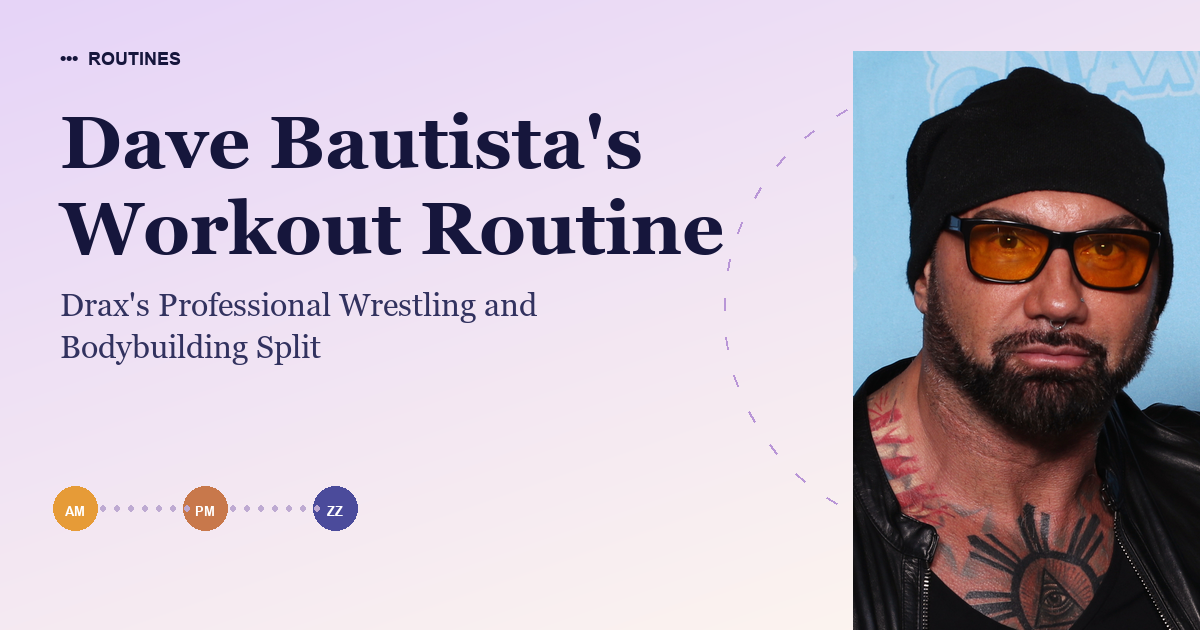
Dave Bautista builds his physique over years of professional bodybuilding and WWE performance preparation rather than through a single film role transformation. The body that plays Drax the Destroyer in the Guardians of the Galaxy films is not assembled in six months for a role. It represents decades of consistent, disciplined training that begins in professional wrestling and evolves through competitive bodybuilding.
His training program sits deliberately in between a conventional bodybuilder's split and an athlete's conditioning program. The loading is not maximum for strength, and the rest periods are shorter than pure powerlifting requires. The combination produces muscle density and cardiovascular conditioning simultaneously.
This article covers the six-day Push-Pull-Legs split Bautista follows, the controlled tempo approach that defines his training philosophy, and the martial arts conditioning that adds athletic capability to his size.
The Training Philosophy
"It's not about how much you lift. It's about how you lift it and what it does for your body long-term." - Dave Bautista
Bautista's approach rejects the ego-driven loading that causes most large men to compromise form for numbers. His program uses slow, controlled tempos on every exercise, with a deliberate eccentric phase that increases time under tension and produces a stronger training stimulus at lower absolute loads than fast, uncontrolled reps at heavier weights would create.
The controlled tempo also reflects a practical longevity consideration. A body trained for decades at Bautista's size accumulates joint stress that sloppy, ballistic lifting accelerates. Precise movement quality at submaximal loads has sustained his training capacity through his 50s without the major injury interruptions that end many professional wrestlers' careers prematurely.
Weekly Training Split
"It's not about how much you lift. It's about how you lift it." - Dave Bautista
| Day | Focus | Rest Between Sets |
|---|---|---|
| Monday | Push (Chest / Shoulders / Triceps) | 30-45 seconds |
| Tuesday | Pull (Back / Biceps) | 30-45 seconds |
| Wednesday | Legs | 60-90 seconds |
| Thursday | Push (Chest / Shoulders / Triceps) | 30-45 seconds |
| Friday | Pull (Back / Biceps) | 30-45 seconds |
| Saturday | Legs or HIIT | 60-90 seconds |
| Sunday | Rest | Full rest |
Push Days: Chest, Shoulders, Triceps
"It's not about how much you lift. It's about how you lift it and what it does for your body long-term." - Dave Bautista
Push days open with machine chest press rather than barbell bench as the primary chest movement. Machine pressing allows the chest to be trained in isolation with constant tension throughout the range of motion, without the shoulder stabilization demand that free weights require. After decades of heavy loading, the shoulder joint benefits from reduced stabilization demand during high-tension pressing movements.
Incline dumbbell press follows as the free-weight pressing movement, developing upper chest fullness that machine pressing cannot replicate through its fixed movement path.
- Machine chest press: 4 sets x 10-12 reps (slow controlled tempo)
- Incline dumbbell press: 4 sets x 10 reps
- Dumbbell fly: 3 sets x 12 reps
- Cable crossover: 3 sets x 15 reps
- Seated dumbbell press: 4 sets x 10 reps
- Lateral raise: 4 sets x 15 reps
- Tricep extension: 4 sets x 12 reps
- Tricep pushdown: 3 sets x 15 reps
Pull Days: Back and Biceps
"It's about how you lift it and what it does for your body long-term." - Dave Bautista
Pull days develop the back width and thickness that creates Bautista's imposing silhouette. The combination of vertical pulling in lat pulldowns and pull-ups with horizontal pulling in rows addresses both the width and depth of the back muscle structure. Bautista's back is one of the most developed aspects of his physique, and the twice-weekly pull-day frequency reflects the priority it receives.
- Weighted pull-ups: 4 sets x 8-10 reps
- Lat pulldown: 4 sets x 12 reps
- Bent-over barbell row: 4 sets x 10 reps
- Seated cable row: 3 sets x 12 reps
- Single-arm dumbbell row: 3 sets x 12 reps per side
- Face pull: 3 sets x 15 reps
- Barbell curl: 4 sets x 12 reps
- Hammer curl: 3 sets x 12 reps
- Concentration curl: 3 sets x 12 reps
Leg Days
"It's not about how much you lift." - Dave Bautista
Bautista's leg sessions use squat variations as the primary movement alongside leg press, leg extension, and leg curl for complete lower body development. The twice-weekly leg training frequency allows more total weekly volume distributed across two sessions, with more recovery between them than the same volume in a single weekly session would allow.
- Back squat: 4 sets x 8-10 reps
- Leg press: 4 sets x 12 reps
- Leg extension: 4 sets x 15 reps (slow controlled tempo)
- Leg curl: 4 sets x 12 reps
- Walking lunge: 3 sets x 12 reps per leg
- Standing calf raise: 5 sets x 20 reps
- Seated calf raise: 4 sets x 15 reps
Martial Arts and HIIT Conditioning
"It's about how you lift it and what it does for your body long-term." - Dave Bautista
Beyond the six-day lifting split, Bautista incorporates martial arts training and high-intensity interval training to develop the cardiovascular fitness and functional athleticism his performance work demands. His martial arts background includes Brazilian jiu-jitsu, Muay Thai, and wrestling, and he continues practicing these disciplines beyond his professional wrestling career.
The HIIT sessions, typically 20 to 30 minutes in duration, use sprint intervals, rowing, and bodyweight circuits to maintain the cardiovascular capacity that allows his large physique to move with the speed and agility visible in his action film appearances.
The Guardians of the Galaxy Preparation
"It's not about how much you lift. It's about how you lift it." - Dave Bautista
For the Guardians of the Galaxy films, Bautista works with Marvel's production team to ensure his physique remains consistent across the multi-year production schedule of the trilogy. Unlike cast members who arrive at Marvel without an established training base, Bautista brings decades of bodybuilding and wrestling conditioning to the role.
Drax's costume design incorporates Bautista's natural muscularity as a core visual element, with the character's tattoos and body paint applied directly to his physique rather than a padded suit. His genuine physical development is directly visible on screen in every scene.
Explore Similar Routines
- The Rock's Workout Routine. Dwayne Johnson's professional wrestling background and subsequent Hollywood physique parallel Bautista's trajectory closely, with both building through WWE performance demands before transitioning to film preparation.
- Chris Pratt's Workout Routine. Pratt's Guardians preparation represents the transformation approach that produces a comparable on-screen result to Bautista's decades of consistent training, showing the difference between built-over-years and built-for-a-role physiques.
- Ronnie Coleman's Workout Routine. Coleman's competitive bodybuilding program shares the high-frequency push-pull-legs structure and volume approach that Bautista adapts from his own bodybuilding background.
- Henry Cavill's Workout Routine. Cavill's Superman preparation pursues a similar density and mass goal to Bautista's sustained physique, achieved through a defined preparation window rather than years of accumulated training.


Bautista's program is built around free-weight pressing, rowing and squatting rather than machines alone, the gear below covers the dumbbell, barbell and heavy-compound work his six-day split leans on, trained at submaximal loads with deliberate eccentrics to spare his joints into his 50s.