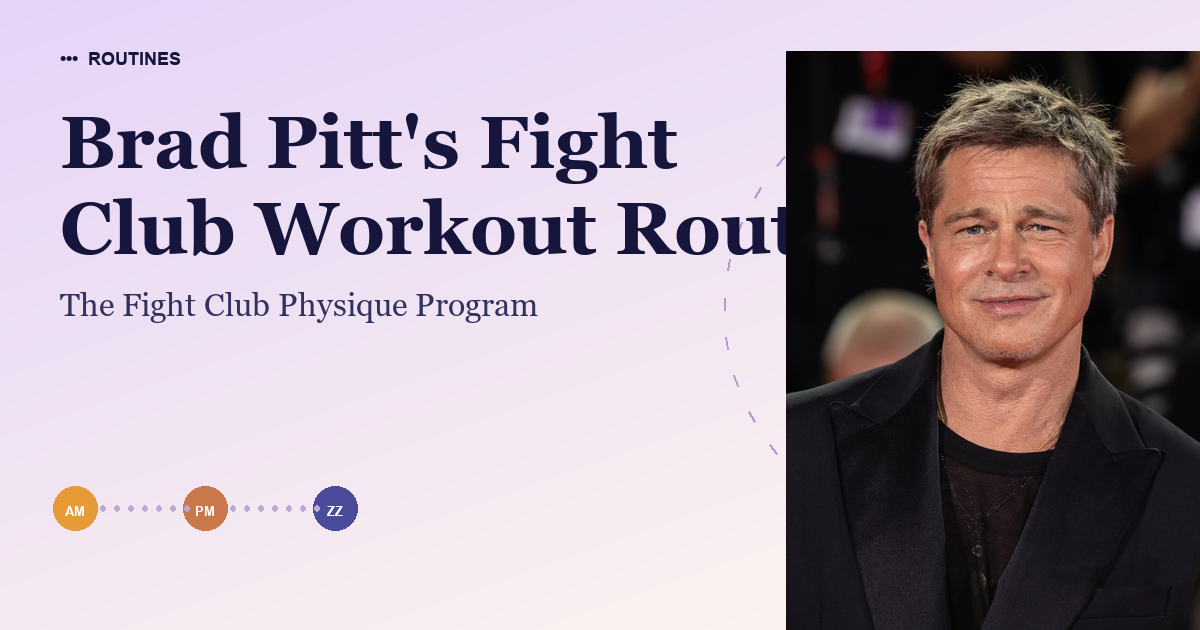
Brad Pitt's Fight Club physique remains one of the most referenced male body standards in fitness history. At 5'11" and approximately 155 pounds with 5 to 6 percent body fat, the result was a physique that looked simultaneously powerful and fast, modeled deliberately on professional boxers rather than bodybuilders.
Trainer David Lindsay had three months to produce the initial transformation, then maintained the condition across five to six months of filming. The program prioritized definition in the triceps, shoulders, and back alongside visible abdominal detail.
This article covers the four-day lifting split Lindsay designed, the cardio protocol that drove the fat loss, and the 2,000-calorie diet that kept Pitt at fight-ready condition throughout production.
The Training Philosophy
"The goal was muscle definition, agility, and a physique modeled after pro boxers. Not size." - David Lindsay, trainer
The deliberate choice to use lower weights at higher repetitions reflects a specific aesthetic goal. Heavy compound lifting at low rep ranges builds muscle tissue that reads as blocky at low body fat. Lighter loads at higher reps build muscular endurance and produce the lean, striated look the Fight Club character required.
Lindsay structures cardio separately from lifting rather than combining them into circuits. Two hours per week on the treadmill at 80 to 90 percent of maximum heart rate creates a dedicated fat-burning stimulus without pre-fatiguing the muscles before lifting sessions.
Weekly Training Split
"I had about three months to complete the look, then maintenance during filming." - David Lindsay, trainer
| Day | Focus | Key Goal |
|---|---|---|
| Monday | Chest | Upper body pressing strength and definition |
| Tuesday | Back | Width and thickness for the V-taper silhouette |
| Wednesday | Shoulders | Capped deltoids and three-dimensional shoulder shape |
| Thursday | Arms | Tricep and bicep definition |
| Friday | Legs | Lean and functional lower body |
| Saturday | Cardio | Fat burning at 80-90% max heart rate |
| Sunday | Rest | Full recovery |
Monday: Chest
"The goal was muscle definition, agility, and a physique modeled after pro boxers." - David Lindsay, trainer
Monday's chest session uses barbell and dumbbell pressing movements to develop fullness without adding excessive mass. Higher rep ranges keep volume high without the load that produces significant hypertrophy. Push-ups finish the session as a blood-flow finisher that reinforces the training stimulus.
- Bench press: 3 sets x 25 reps
- Incline dumbbell press: 3 sets x 15 reps
- Dumbbell fly: 3 sets x 15 reps
- Cable crossover: 3 sets x 15 reps
- Push-ups: 3 sets to failure
Tuesday: Back
"He had to build his triceps and shoulders, widen his back, and bring out the definition in his abs." - David Lindsay, trainer
Tuesday back work focuses on the lat width that creates the V-taper silhouette visible throughout Fight Club's shirtless sequences. Pull-ups are the primary movement, valued for their ability to develop lat spread without the loading that turns back thickness into bulk.
Bent-over rows and cable rows add pulling strength and mid-back thickness that fills out the rear view without widening the waist.
- Pull-ups: 3 sets x 15 reps
- Seated cable row: 3 sets x 15 reps
- Bent-over barbell row: 3 sets x 15 reps
- Lat pulldown: 3 sets x 15 reps
- Face pulls: 3 sets x 15 reps
Wednesday: Shoulders
"He was at just five to six percent body fat for the film." - David Lindsay, trainer
Shoulders are a primary development target because capped, rounded deltoids create the visual illusion of a narrower waist and more powerful upper body without requiring significant additional mass. Lindsay emphasizes lateral and rear delt work alongside overhead pressing to develop three-dimensional shape rather than simply front delt bulk from pressing alone.
- Arnold press: 3 sets x 15 reps
- Lateral raise: 3 sets x 15 reps
- Front raise: 3 sets x 15 reps
- Rear delt fly: 3 sets x 15 reps
- Upright row: 3 sets x 15 reps
Thursday: Arms
"The goal was muscle size (hypertrophy) and muscle endurance." - David Lindsay, trainer
Triceps receive more emphasis than biceps in this program. Triceps account for roughly two-thirds of the upper arm's mass, and the horseshoe definition of a well-developed tricep reads clearly on camera. Lindsay programs pushdowns, overhead extensions, and dips as the primary tricep movements.
- EZ bar curl: 3 sets x 15 reps
- Hammer curl: 3 sets x 15 reps
- Concentration curl: 3 sets x 15 reps
- Tricep pushdown: 3 sets x 15 reps
- Overhead tricep extension: 3 sets x 15 reps
- Bench dips: 3 sets x 15 reps
Friday: Legs and Abs
"He was probably clocking in at around 155 pounds on his 5-foot 11-inch frame." - David Lindsay, trainer
Friday leg work is kept proportional to the upper body focus of the program. The Fight Club character did not require exceptional leg development, and over-emphasizing lower body mass would undermine the lean fighter physique the role demanded.
Abs are trained daily throughout the program, with an additional dedicated circuit on Fridays.
- Squat: 3 sets x 25 reps
- Leg press: 3 sets x 15 reps
- Walking lunge: 3 sets x 15 reps per leg
- Leg curl: 3 sets x 15 reps
- Calf raise: 4 sets x 20 reps
- Crunches: 3 sets x 25 reps
- Hanging leg raise: 3 sets x 15 reps
- Plank: 3 x 45 seconds
The Cardio Protocol
"Pitt was only doing two hours on a treadmill per week, but he made those two hours count by really pushing himself at 80-90 percent of his maximum heart rate." - David Lindsay, trainer
Saturday cardio runs for approximately one hour on the treadmill at 80 to 90 percent of maximum heart rate. This intensity sits above the moderate-intensity fat-burning zone and below all-out sprint effort, producing significant caloric expenditure while remaining sustainable for the full session.
Lindsay kept total weekly cardio at two hours deliberately. Excessive cardio would compromise muscle retention on a 2,000-calorie diet.
The Diet
"Brad Pitt's Fight Club diet comprised high-protein foods and little to no carbs to lean him out while building muscle." - David Lindsay, trainer
Pitt's Fight Club diet sits at approximately 2,000 calories per day, structured around high protein, moderate carbohydrate, and low fat. The foods are simple and consistent: chicken, fish, brown rice, pasta, green vegetables, and oatmeal.
The absence of processed food, refined sugar, and alcohol within the caloric target creates the deficit needed to reach sub-6% body fat without extreme restriction that would undermine training performance.
Explore Similar Routines
- Jason Statham's Workout Routine. Statham's trainer Logan Hood built a program around the same fighter-physique goal, using pyramid circuits and interval training to develop functional leanness rather than bodybuilder mass.
- Jake Gyllenhaal's Workout Routine. Gyllenhaal's Southpaw and Road House preparations pursued the same lean, fight-ready aesthetic as Fight Club through boxing conditioning and precise body fat targeting.
- Daniel Craig's Workout Routine. Craig's Casino Royale transformation with Simon Waterson pursued a similar lean, powerful aesthetic through compound lifting and conditioning rather than bodybuilding methods.
- Henry Cavill's Workout Routine. Cavill's Superman preparation contrasts with Pitt's approach, using 5,000 calories and maximum muscle accumulation to produce a physique at the opposite end of the body composition spectrum.
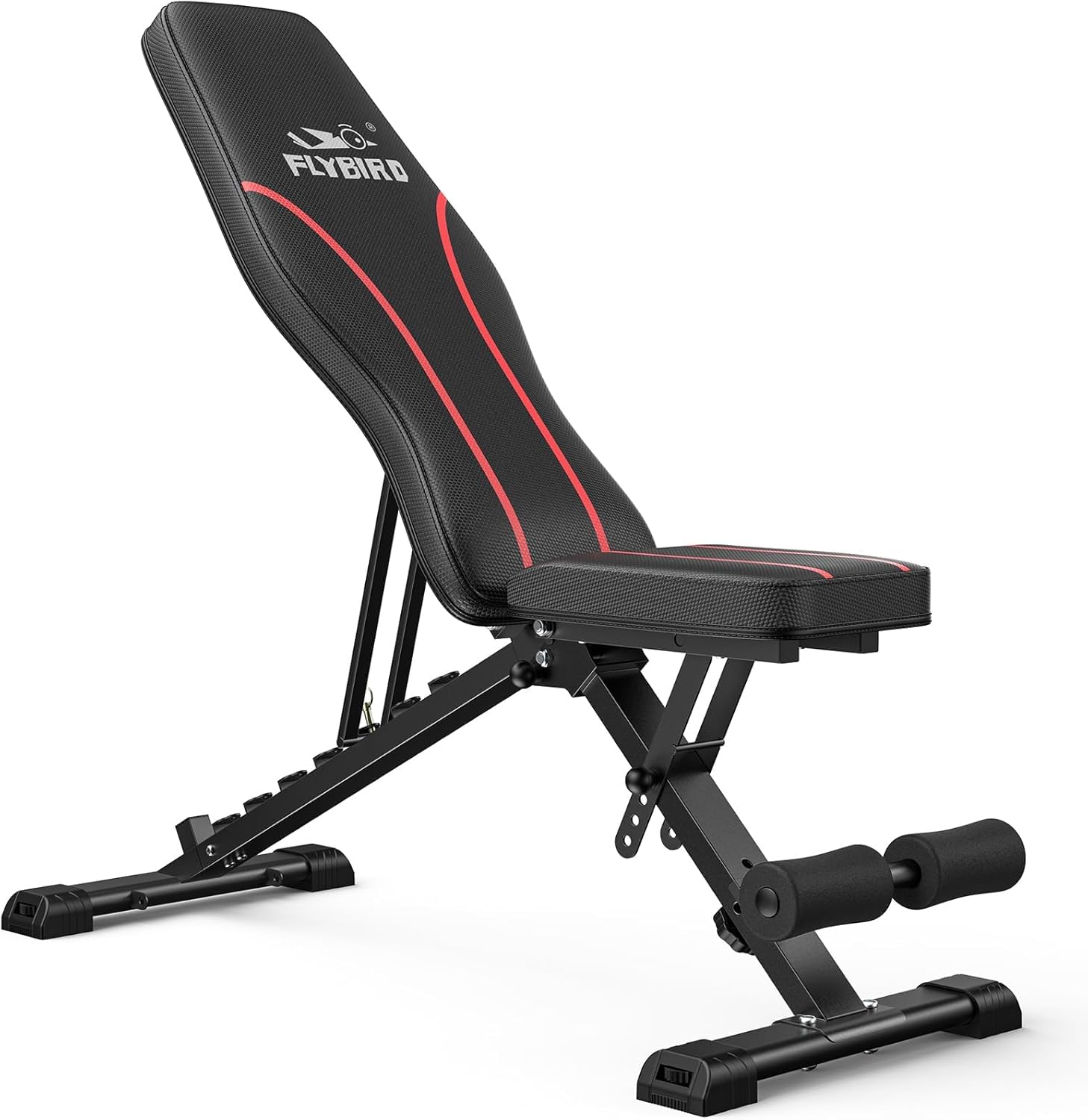

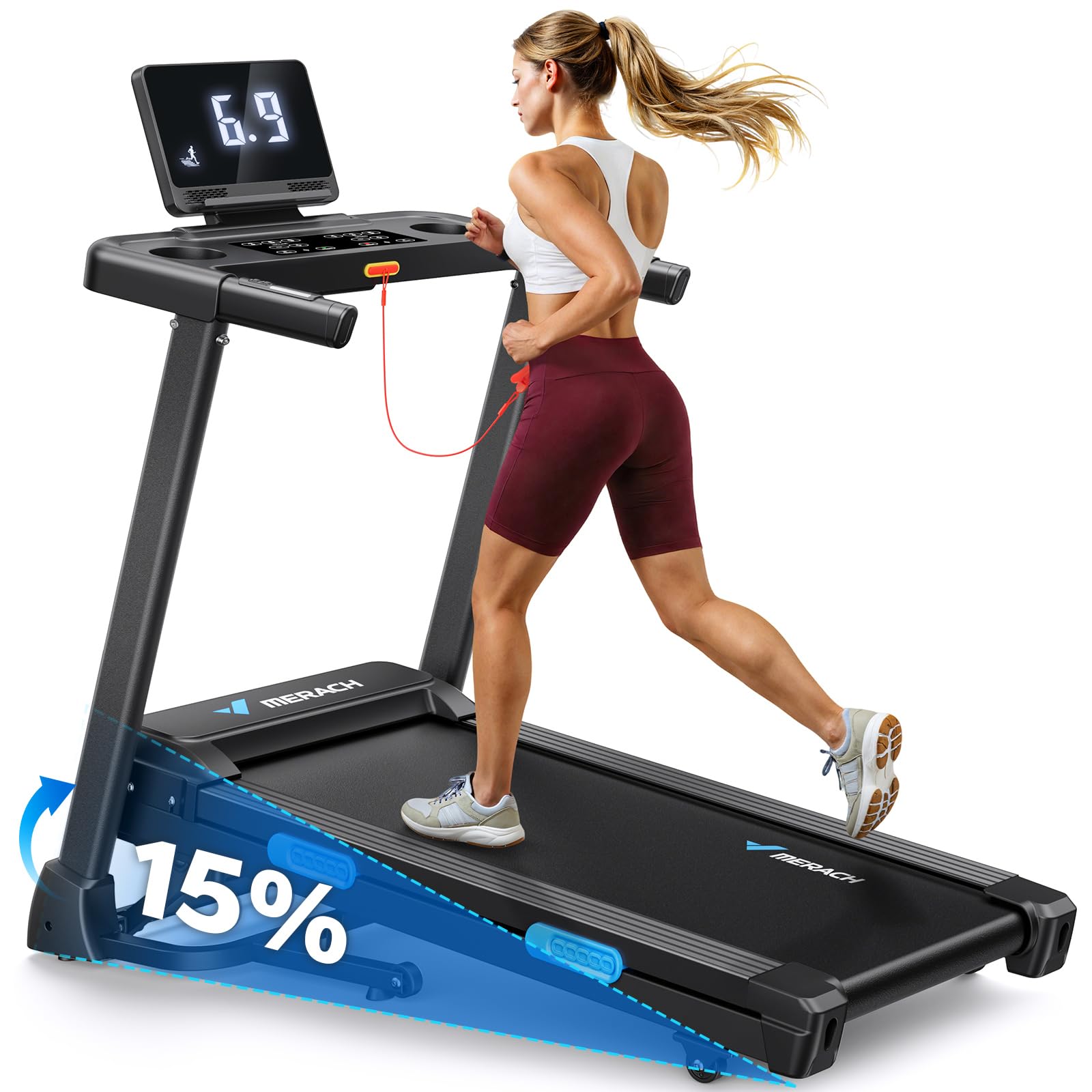
The Fight Club program ran on lighter loads at higher reps to build the lean, striated boxer's look rather than blocky mass. These are the home-gym pieces that let you replicate the four-day split and the dedicated treadmill cardio behind the fat loss.