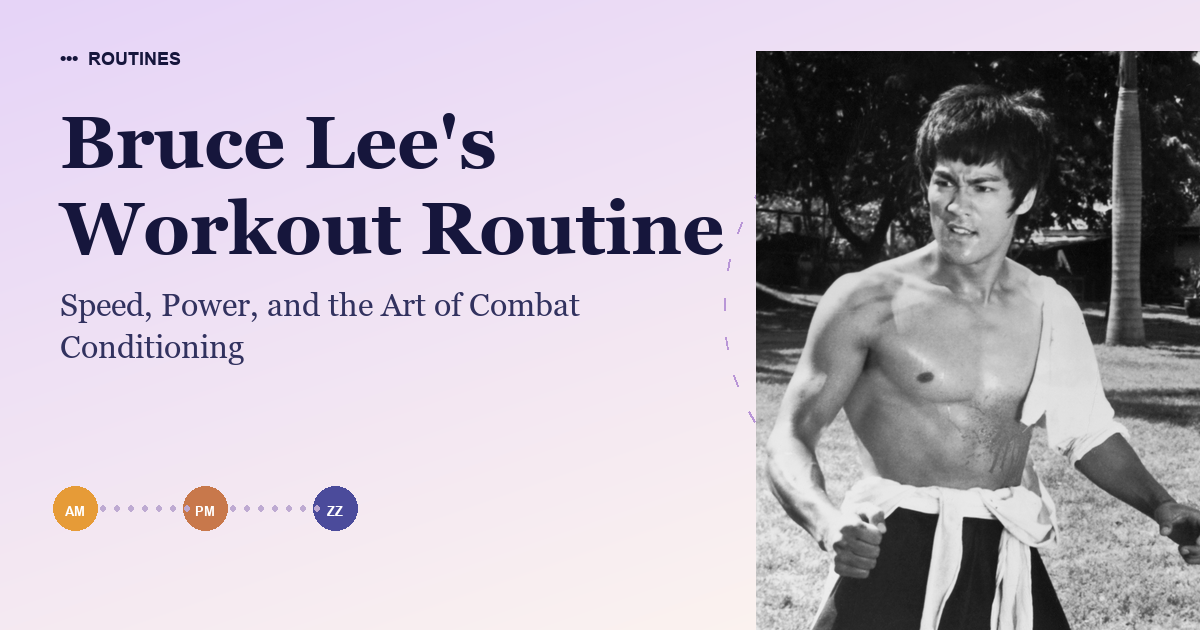
Bruce Lee trained with the obsessive precision of a scientist and the discipline of a monk. The founder of Jeet Kune Do, Lee built one of the most functional and visually remarkable physiques in history through a training system he designed himself, drawing on martial arts, boxing, weightlifting, and cardiovascular conditioning long before cross-training was a recognized concept.
This article covers Bruce Lee's full workout routine: his daily running practice, strength training exercises, isometric and stretching protocols, martial arts training, and the nutrition and supplementation approach he documented in his personal notes and training journals.
Details come from Lee's own writings, including "The Art of Expressing the Human Body," compiled by John Little, as well as interviews with his wife Linda Lee Cadwell and training partners.
Training Philosophy
"If you always put limits on everything you do, physical or anything else, it will spread into your work and into your life. There are no limits. There are only plateaus, and you must not stay there, you must go beyond them."
Bruce Lee viewed the human body as a tool to be perfected through constant, varied training. He rejected the idea that any single martial art or fitness system was complete.
His approach was radically ahead of its time. He combined aerobic running, resistance training, flexibility work, isometric exercises, and martial arts into a single daily system when most athletes trained in only one modality.
Lee documented every session in his training journals, tracking exercises, sets, reps, and weights with the same attention he brought to his martial arts research. His physique at 5'7" and 135 pounds was the product of deliberate, scientific programming, not luck or genetics.
"I fear not the man who has practiced 10,000 kicks once, but I fear the man who has practiced one kick 10,000 times."
Weekly Training Split
| Day | Session 1 | Session 2 |
|---|---|---|
| Monday | Run (1-6 miles) | Weight Training + Martial Arts |
| Tuesday | Cycling (45 min) | Martial Arts + Stretching |
| Wednesday | Run (1-6 miles) | Weight Training + Martial Arts |
| Thursday | Cycling (45 min) | Martial Arts + Isometrics |
| Friday | Run (1-6 miles) | Weight Training + Martial Arts |
| Saturday | Cycling or Run | Stretching + Skill Work |
| Sunday | Rest or light activity |
Lee trained twice per day, six days per week. He alternated running and cycling for cardiovascular work and kept weight training to three days per week to allow muscular recovery while maintaining daily martial arts practice.
Running Program
Lee ran between one and six miles every Monday, Wednesday, and Friday. He typically ran in the early morning, often between 6 and 8 AM, at a conversational pace designed to build aerobic base without generating the fatigue that would compromise his afternoon martial arts sessions.
"Running is one of the best exercises there is."
Lee viewed running as the cardiovascular foundation that made everything else possible. He understood that no amount of martial arts speed or power could be expressed without the aerobic engine to sustain it.
He frequently wore a rubber suit while running to increase sweat and caloric burn, a practice that reflects both his era and his willingness to push physical limits well beyond conventional standards.
Cycling
On non-running days, Lee cycled for approximately 45 minutes on a stationary bike. He kept the intensity moderate, using cycling as active recovery that maintained his heart rate without adding impact stress to his legs.
The cycling sessions gave him two additional cardiovascular workouts per week without the joint load of daily running, an early intuition about training load management that modern coaches now formalize as polarized periodization.
Weight Training
Lee trained with weights three days per week, using a combination of barbell, dumbbell, and cable exercises. His goal was functional strength at his bodyweight, which he maintained at 130 to 145 pounds depending on his training phase.
"The athlete who is building muscles through weight training should be very sure to work adequately on speed and flexibility at the same time."
Bruce Lee's Weight Training Exercises
| Exercise | Sets x Reps | Focus |
|---|---|---|
| Clean and Press | 2 x 8 | Full-body power and shoulder strength |
| Barbell Squat | 2 x 12 | Lower body strength and leg power |
| Barbell Row | 2 x 8 | Upper back pulling strength |
| Bench Press | 2 x 6 | Horizontal pressing power |
| Barbell Curl | 2 x 8 | Bicep strength and arm development |
| Dumbbell French Press | 4 x 6 | Tricep strength for punching power |
| Dumbbell Concentration Curl | 4 x 6 | Peak bicep contraction |
| Reverse Curl | 4 x 6 | Forearm and wrist strength |
| Wrist Curl | 4 x 6 | Grip and forearm endurance |
Forearm and Grip Training
Lee was obsessive about forearm and grip strength. He used a grip machine and wrist roller daily, sometimes squeezing a tennis ball throughout the day to build the crushing hand strength that made his one-inch punch so devastating.
He also used a spring-loaded grip exerciser between training sessions, treating forearm work as a movement he could do anywhere, anytime, separate from his formal training blocks.
Isometric Training
Lee integrated isometric exercises into his routine specifically to build strength at the joint angles most relevant to striking. Isometrics involve contracting a muscle against an immovable resistance, producing strength gains at the exact position of the contraction.
"The isometric method of exercising can be applied to almost every part of the body."
He used a tension bar mounted in a power rack and pushed or pulled against it at specific positions in his striking range of motion. This trained the precise joint angles where punches and kicks generate force, adding targeted strength that conventional lifting could not replicate.
Bruce Lee's Isometric Protocol
| Exercise | Duration | Muscle Group |
|---|---|---|
| Chest Press Hold | 6-12 seconds | Chest and anterior deltoid |
| Upright Row Hold | 6-12 seconds | Shoulders and upper back |
| Curl Hold (elbow at 90 degrees) | 6-12 seconds | Biceps at mid-range |
| Squat Hold (quarter position) | 6-12 seconds | Quadriceps and glutes |
| Deadlift Hold (off floor) | 6-12 seconds | Full posterior chain |
Abdominal Training
Lee's abdominals were the most commented-upon feature of his physique. He trained his core daily, treating it as a separate category that required its own dedicated work rather than a byproduct of other lifting.
"The abdominal and waist region coordinate all movement. This area has to be strong."
Bruce Lee's Abdominal Routine
| Exercise | Sets x Reps | Focus |
|---|---|---|
| Sit-Ups | 4 x failure | Overall core strength and endurance |
| Leg Raises | 4 x failure | Lower abdominals and hip flexors |
| Side Bends | 4 x 50 | Obliques and lateral core |
| Twists (standing bar) | 4 x 50 | Rotational power and spinal mobility |
| Leaning Twists | 4 x 50 | Obliques under extension |
| Frog Kicks | 4 x failure | Lower abs and hip flexor endurance |
He performed this circuit daily, often in the morning before other training. The volume was high by any standard, and the daily frequency reflected Lee's view that the core was a foundational structure that needed constant reinforcement.
Stretching and Flexibility
Lee stretched every day, treating flexibility as a performance output rather than an afterthought. He could perform a standing side kick to head height and execute a full split, and he maintained this range of motion through structured daily stretching.
"Flexibility is crucial to the martial artist. A joint that cannot flex fully is a joint that cannot generate its full range of force."
His stretching sessions included hamstring stretches, hip flexor holds, shoulder and chest openers, and full spinal rotations. Sessions typically ran 30 to 45 minutes, often performed in the evening after his main training to take advantage of elevated core body temperature.
Martial Arts Training
Jeet Kune Do practice was the centerpiece of Lee's day. He trained footwork, striking combinations, trapping, and sparring across multiple sessions each week with his students and training partners, including Dan Inosanto and Ted Wong.
"Jeet Kune Do is not a special kind of technique. I call it the art of expressing the human body."
A typical JKD session included shadowboxing, pad work, heavy bag rounds, Chi Sao (Wing Chun sticky hands drills), kicking practice on the wooden dummy, and live sparring. Lee trained the wooden dummy daily at his home gym, logging thousands of repetitions of defensive and counter-attacking patterns.
Bruce Lee's Martial Arts Training Tools
- Wing Chun wooden dummy. Daily structural drilling and hand sensitivity training
- Heavy bag. Power development and cardio conditioning through punching and kicking rounds
- Kicking shield. Partner pad work for speed and accuracy
- Speed bag. Timing, rhythm, and upper body endurance
- Grip exerciser. Daily forearm and grip conditioning between sessions
Nutrition
Lee ate a protein-rich diet and was an early adopter of protein supplementation, using protein powder at a time when it was uncommon outside competitive bodybuilding. He juiced vegetables and fruits daily, blending drinks that included carrots, celery, apples, and occasionally beef liver.
His personal writings document protein shakes made with milk, eggs, peanut butter, bananas, and brewer's yeast. He was decades ahead of the modern nutrition culture that now treats high-protein, whole-food fueling as a cornerstone of athletic performance.
Post-Workout Recovery
Lee prioritized protein intake after training and used deep tissue massage and stretching sessions to manage soreness from the volume his schedule demanded. Sleep was protected, typically eight or more hours per night, which Lee considered as important as the training itself.
The System
Bruce Lee's training system was built on one principle: everything must serve the goal of being a more complete martial artist and human being. He did not train to be a bodybuilder or a powerlifter; he trained to be capable in every dimension simultaneously.
The combination of daily cardiovascular work, three-day weight training, isometric holds, core training, flexibility sessions, and martial arts practice produced the most iconic athletic physique of the twentieth century. That physique was a byproduct, not the goal.
What made Lee's approach transferable was his rigorous self-documentation: detailed training logs, measured progress, and program adjustments based on what the data showed. He brought a researcher's discipline to a domain most people treat with guesswork.
"A goal is not always meant to be reached. It often serves simply as something to aim at."
Explore Similar Routines
- Conor McGregor's Workout Routine. The MMA training system behind one of the most explosive fighters in UFC history.
- George St-Pierre's Workout Routine. The disciplined, science-based training split behind the greatest MMA champion of all time.
- Joe Rogan's Workout Routine. A BJJ black belt's full weekly training split combining martial arts, kettlebells, and yoga.
- Arnold Schwarzenegger's Workout Routine. The legendary training system behind the greatest bodybuilder of all time.